

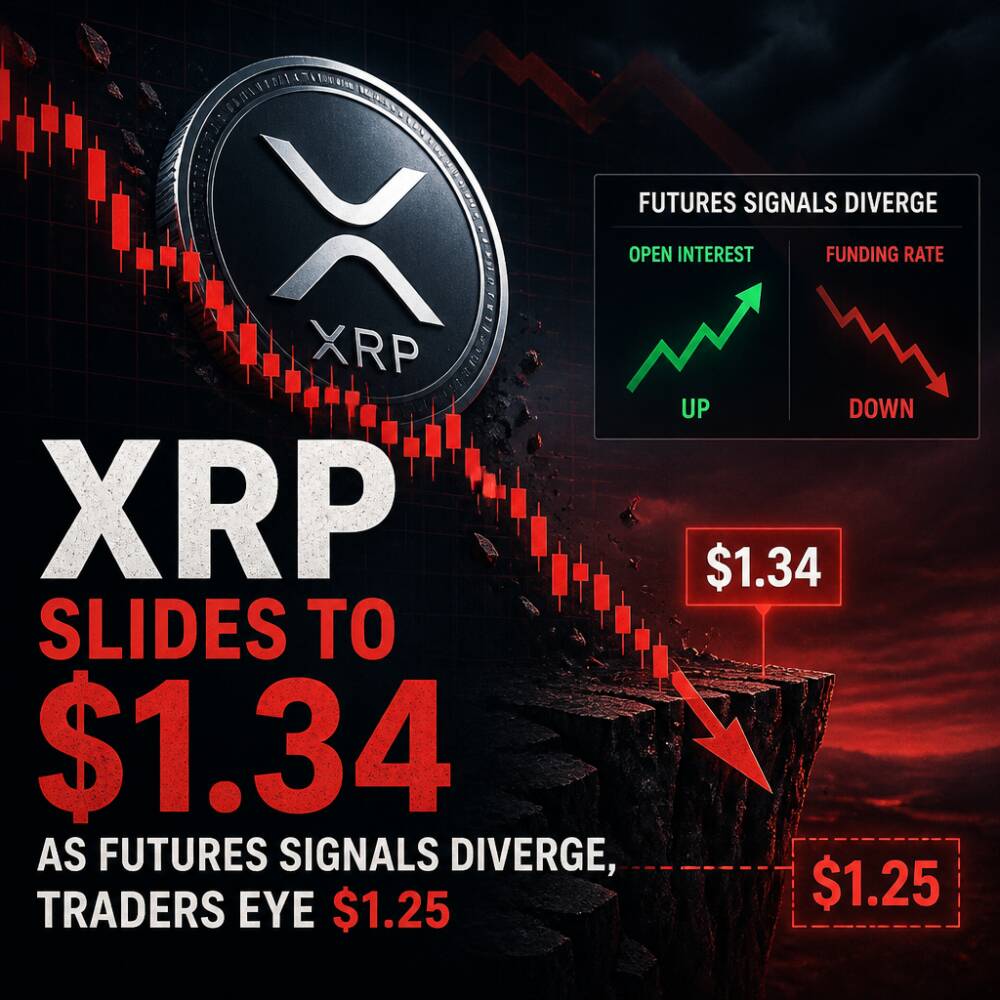
XRP traded near $1.34 on Thursday, extending a cautious tone after buyers failed to build on a recent rebound. The token remained below a cluster of widely watched moving averages, while derivatives positioning signaled a split between bearish spot sentiment and bullish funding flows in perpetual futures.
Key takeaways
- Price move: XRP hovered around $1.34, staying under key moving averages.
- Catalyst: Futures activity showed conflicting signals—a bearish long-to-short skew alongside positive funding rates.
- Key implication: Tight technical levels mean XRP’s next direction depends on whether it can reclaim the $1.375 resistance zone.
- Risk level: Losing nearby support could reopen the path toward $1.300 and potentially $1.25.
What drove the move
Derivatives data pointed to uneven positioning. According to CoinGlass, XRP’s long-to-short ratio stood at 0.86 on Thursday—near the lowest level observed in more than a month. Ratios below one typically indicate that short positions outweigh longs within the tracked accounts, reinforcing a bearish tilt in measured futures exposure.
At the same time, XRP’s funding rate turned positive earlier in the week and reached 0.0064% on Thursday, according to the article. Positive funding means traders holding long perpetual futures positions pay those on shorts, which generally suggests continued demand for bullish exposure despite the heavier short presence implied by the long-to-short ratio.
The divergence matters because it reduces confidence that the market’s positioning is aligned with a sustained rebound. In this setup, traders may be taking opposing views simultaneously—some betting on upside through perpetual longs even as overall measured positioning remains skewed toward shorts.
CryptoQuant’s market summary added further context on order flow. The report highlighted large whale orders and “heating” conditions across spot and futures markets, alongside sell-side dominance in futures trading. While large orders alone do not determine direction, the combination of sizable demand and stronger selling pressure in futures can keep price action choppy, with buyers struggling to control momentum.
Technical picture: resistance and support in focus
On the chart, XRP’s near-term bias remained soft. The daily and four-hour structure held a bearish tendency, with the token trading below the 200-day exponential moving average near $1.374 and the 50-day EMA close to $1.375. Because these moving averages are clustered closely, the zone around $1.374–$1.375 acts as the first resistance level traders will watch for a technical turn.
Momentum indicators also suggested limited upside follow-through. The relative strength index sat around 44, below the neutral 50 mark, while the MACD remained marginally negative. Together, these readings indicate that bears retained some influence, even as XRP showed attempts to recover.
For a constructive shift, the article noted that a sustained move above $1.374–$1.375 could reduce immediate pressure and bring additional overhead supply into view. If buying broadens, the horizontal resistance near $1.540 would likely become the next reference point, with a higher barrier around $1.900 relevant only if a wider recovery develops.
Downside levels were equally important. XRP held above its 100-day EMA near $1.337, providing an initial cushion. A break below that average would likely refocus attention on $1.300 support. The article also flagged that a daily close under $1.300 would weaken the stabilization attempt and raise the risk of another leg down toward the swing low near $1.25.
What to watch next
With XRP trapped between nearby support and tightly grouped resistance, the next move is likely to hinge on whether spot demand can overcome selling in futures and whether funding strength persists alongside improved spot momentum. Traders will be watching for reclaiming the $1.375 area, while any sustained breakdown below $1.300 could be a prompt for renewed downside positioning.


