

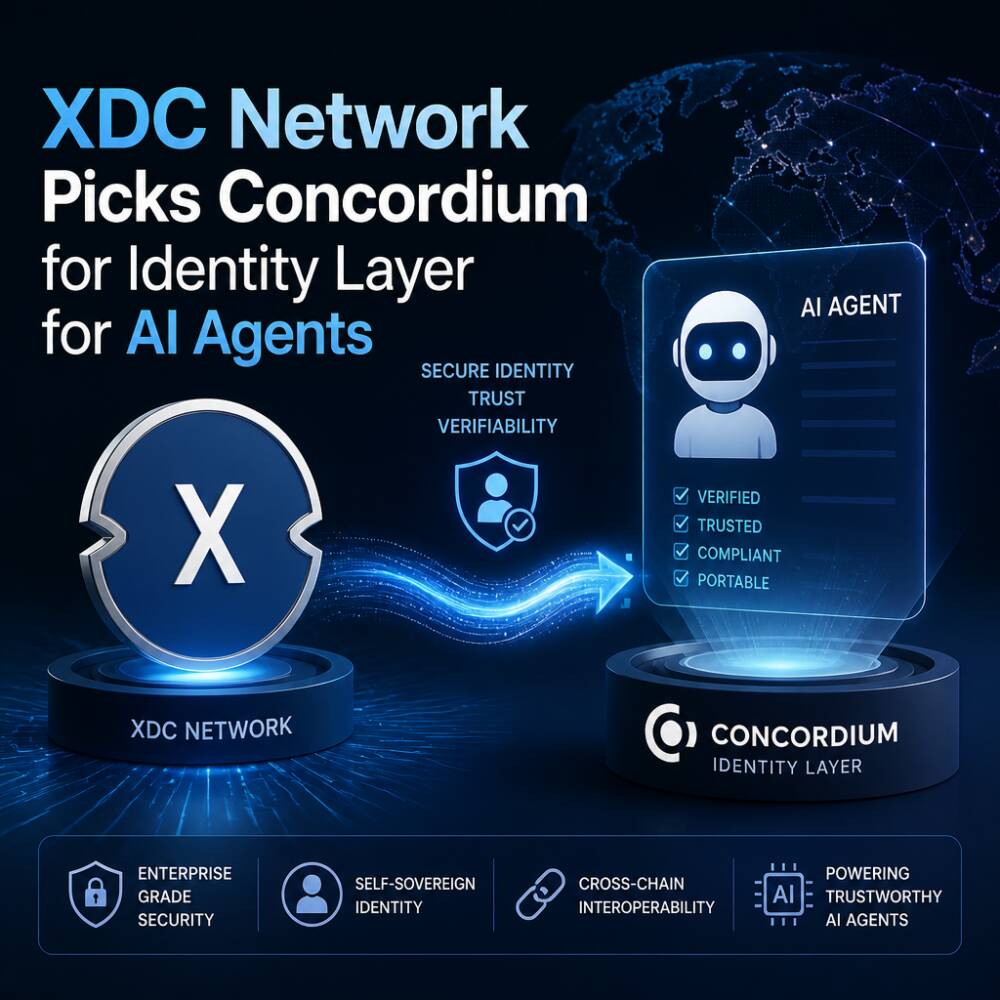
XDC Network has named Concordium its exclusive identity verification provider for XDC AI, the platform’s marketplace focused on payments involving AI agents. The move adds an onchain verification badge intended to connect an AI agent’s activity to a verified individual or business—without requiring the owner’s public disclosure.
According to Concordium and XDC Network, the integration is designed to support accountability for agents that execute financial transactions or act on behalf of companies. Agents continue to use their existing non-custodial wallets on XDC AI, while Concordium supplies the identity layer and issues a publicly verifiable badge tied to verification status.
Key takeaways
- XDC Network selected Concordium as the exclusive identity verification provider for XDC AI’s agent marketplace.
- New feature: AI agents can obtain an onchain verification badge linked to a verified person or business while keeping personal details offchain.
- Catalyst: integration of identity verification into XDC AI’s agent payment workflow, including badge issuance and wallet linking.
- Implication: the partnership aims to make agent-to-agent and agent-to-business payments more institutionally accountable by verifying who stands behind an agent.
- Developer friction reduced: Concordium says network fees are sponsored, so developers do not need to hold Concordium’s CCD tokens to use the verification service.
What drove the move
XDC AI, launched in July 2026, provides non-custodial wallets that enable AI agents to discover and pay for services using USDC under the x402 payment standard. With the Concordium integration, the platform adds an identity verification step that produces a verification badge for each agent, confirming that a verified individual or business is associated with that agent.
Concordium said the system is built to establish “accountability” for agents operating in payment contexts—particularly where transactions may be conducted on behalf of organizations. The verification process is intended to be privacy-preserving: personal information is kept offchain, while the badge remains publicly verifiable onchain.
How the identity verification works
According to Concordium, agent owners complete verification through the Concordium Wallet by providing a passport and completing a liveness check via an independent identity provider. After verification, owners link their XDC wallet through two signatures. Concordium said these signatures do not transfer funds and are used to register the agent.
Once linked, Concordium issues a publicly verifiable badge intended to signal that the agent is backed by a verified entity. The company said that disclosure of an owner’s identity would require a court order and joint action by independent Privacy Guardians.
Concordium also said that while it introduces the identity layer, agents retain their existing wallets, code, and operations on XDC. In other words, the integration is positioned as an add-on verification mechanism rather than a change to how agents operate on the XDC network.
Market reaction and investor implications
The announcement does not cite any token price moves or market performance data. However, the direction of the change is notable for investors watching how blockchain platforms attempt to address trust and compliance challenges in onchain commerce.
For market participants, the key implication is the focus on institutional-style verification in an agent payments context. AI agents can already transact onchain, but identity and liability have been central issues for regulated counterparties. By tying agents to a verified person or business via a privacy-preserving badge, XDC AI and Concordium are aiming to reduce uncertainty about “who is behind the payment.”
Concordium said the integration is available through xdcai.tech/agent-verification, with developer documentation published at docs.xdcai.tech/wallet/agent-verification. The partnership also includes a revenue-sharing arrangement for each agent verification, and Concordium said that each verified agent results in a Concordium account being linked to the verified owner.
Bigger picture for AI agents and onchain commerce
Concordium stated that it already supports AI agent verification on Ethereum and Solana, and that XDC is the first full-network integration for its approach. The company framed the work as network-agnostic from a verification standpoint, emphasizing that accountability matters more than the underlying blockchain used by the agent.
Beyond onboarding and verification, Concordium said network fees are sponsored for developers using the verification service. That detail is relevant because sponsored fees can lower operational costs and integration barriers for builders, potentially encouraging more agent deployments and verification usage without requiring developers to hold CCD tokens.
In addition to expanding XDC AI’s compliance-related tooling, the partnership signals a broader push across the industry to combine onchain autonomy with identity controls—especially for workflows that involve payments, service purchases, and business representation by automated agents.
Looking ahead, developers and users will likely watch for how quickly agent operators adopt the verification workflow, and whether more networks follow XDC in integrating Concordium’s identity layer. The next practical signals to monitor are updates to agent verification tooling, any expansion of supported networks, and ongoing development around XDC AI’s payment and onboarding capabilities.


