

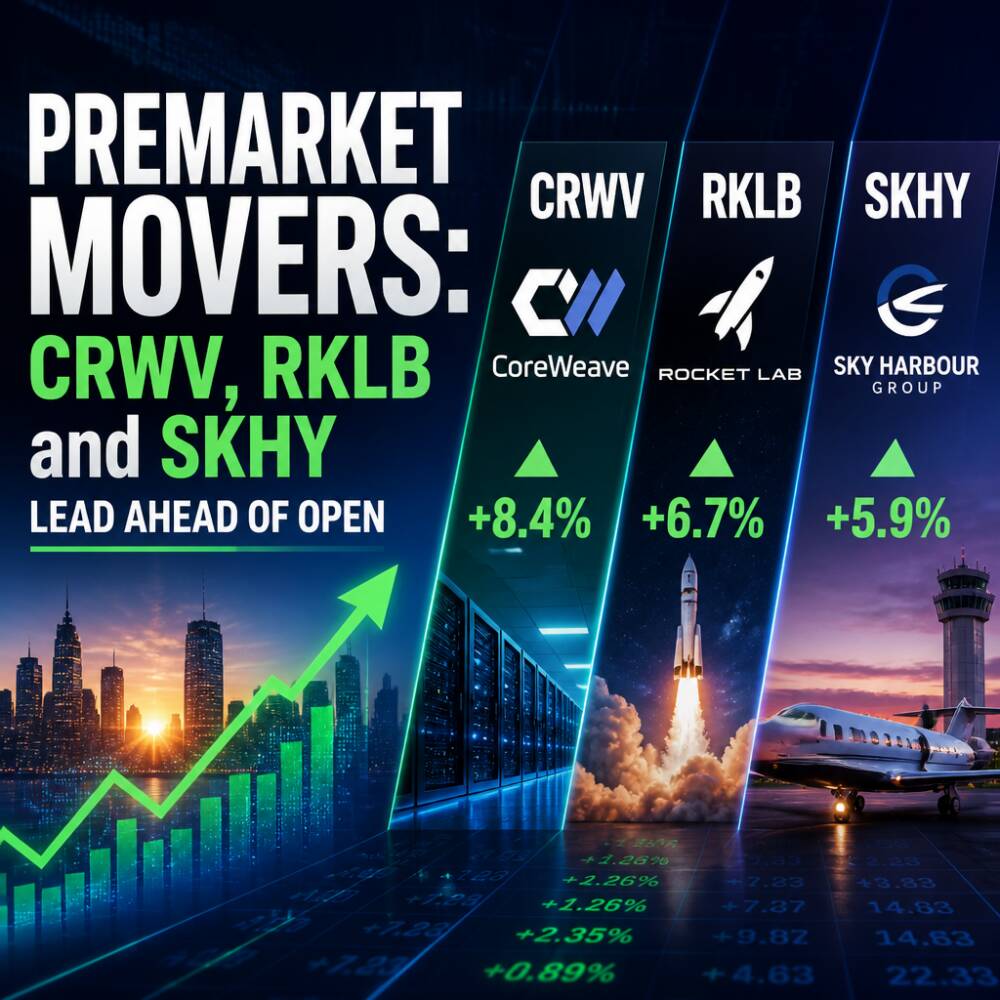
Stocks moving in premarket trade on Thursday reflected a mix of deal activity, corporate updates, and investor caution around how companies are financing artificial intelligence expansion. Cloud infrastructure provider CoreWeave slid for a second straight session, while Rocket Lab fell after pushing back a key launch milestone. Separately, Penske Automotive surged on a proposed going-private transaction, and Walmart and Crocs gained after analyst upgrades.
Key takeaways
- Price move: CoreWeave shares fell about 6% for a second day; Rocket Lab dropped nearly 10% after a launch delay.
- Catalyst: Investors weighed concerns that AI build-outs may be increasingly reliant on borrowing, alongside company-specific timelines and financing questions.
- Deal-driven rally: Penske Automotive rose roughly 8% after announcing plans to be taken private at $212 per share in cash.
- Analyst support: Walmart gained more than 2% after Deutsche Bank upgraded the stock; Crocs climbed nearly 2% following a Barclays upgrade.
- Market backdrop: The moves came as South Korea’s Kospi fell overnight and broader risk appetite appeared muted.
AI financing concerns and launch delays weigh on growth names
CoreWeave shares declined about 6% in premarket, extending losses for a second day. According to the CNBC report, investors were increasingly concerned that CoreWeave—and other technology companies—may be borrowing too much to fund artificial intelligence infrastructure build-outs. The selloff suggests investors are looking beyond long-term AI demand and focusing on balance-sheet risk and financing sustainability.
Rocket Lab also moved sharply lower, with shares down nearly 10% after the company delayed the launch of its Neutron rocket to 2027. The change pushes out a timeline that investors may have been using to gauge the pace of commercialization and future revenue potential, and it highlights how schedule risk remains a key swing factor for space-sector names.
In Asia, SK Hynix shares fell more than 7% as investors appeared concerned about how the chipmaker would fund AI-related expansion. The decline followed a 7.6% overnight drop in South Korea’s Kospi index, adding a macro layer to the stock-specific selling and underscoring that regional risk sentiment was already under pressure.
Deal news lifts Penske Automotive; premium signals investor negotiation
Penske Automotive stood out among the biggest gainers, rising about 8% after the company said it would be taken private by Motown Acquisition Corp., an entity owned by Penske Corp. and Mitsui. The proposed price is $212 per share in cash, representing a nearly 9% premium to Wednesday’s closing price of $194.79 per share, according to the CNBC report.
The transaction is expected to close in the first quarter of 2027. For investors, the key implication is that the market is repricing the shares from trading fundamentals toward deal mechanics—specifically, deal certainty and the path to closing. Premium pricing also indicates that the buyer structure sees room to acquire at terms that are acceptable relative to the company’s recent valuation.
Retail and footwear find support from upgrades
Walmart gained more than 2% after Deutsche Bank upgraded the retailer to buy from hold. The bank cited a constructive outlook for 2027, including expectations that incremental margins could improve. Deutsche Bank also noted that current inflation levels could help the company attract consumers, suggesting the upgrade is grounded in both profitability trajectory and demand conditions.
Crocs advanced nearly 2% following a Barclays upgrade to overweight from equal weight. Analyst Adrienne Yih pointed to progress on product innovation and category expansion, along with growth in the company’s international business. The upgrade indicates that Barclays sees execution momentum as supportive of future earnings power, rather than relying solely on broad consumer tailwinds.
What investors will watch next
With several AI- and growth-linked names responding to financing and timeline risk, investors are likely to focus on how companies fund expansion plans and whether revised schedules affect near-term milestones. For deal-related holders, attention will turn to steps toward closing in 2027. In addition, upcoming earnings reports and any incremental guidance updates from companies tied to AI infrastructure, space launches, and consumer demand are likely to drive the next wave of premarket and early-session moves.


