

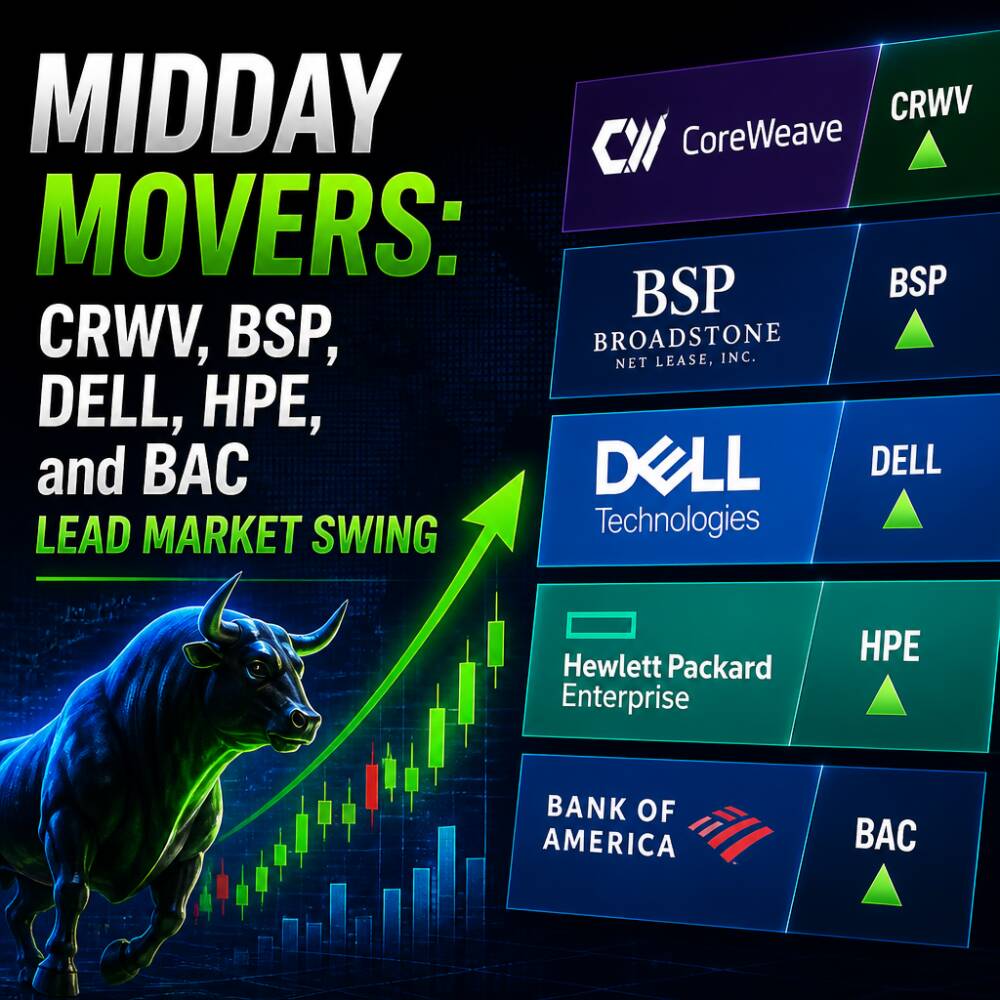
Midday trading saw sharp moves across a range of sectors, from quantum computing and artificial intelligence infrastructure to semiconductors and major asset managers. IonQ slid after announcing a large equity offering, while Berkshire Hathaway’s new stake pushed Bending Spoons higher. In banking, Bank of America fell on a U.S. Treasury-related penalty, and CoreWeave dropped amid reports of weakness in its bond market.
Key takeaways
- IonQ shares fell 8% after the company announced a $2 billion equity offering, signaling dilution risk to investors.
- Bending Spoons surged 40% after Berkshire Hathaway made a new $330 million investment, reinforcing confidence in its long-term growth outlook.
- CoreWeave dropped 15% as Bloomberg reported sharp losses in its bonds, raising concerns about financing conditions.
- Bank of America fell 7% following a $1.2 billion penalty tied to U.S. money-laundering violations, weighing on profitability.
- BlackRock rose about 1% after earnings and revenue beat expectations, with assets under management climbing year over year.
What drove the biggest stock moves
Equity issuance weighed on IonQ. Shares of IonQ dropped 8% after the quantum computing company said it plans to raise $2 billion through an equity offering. The news came shortly after IonQ agreed to acquire cybersecurity firm Elisity in an all-stock transaction valued at up to $1.3 billion, leaving investors focused on how capital needs and deal financing could affect future share supply and dilution.
Berkshire Hathaway’s follow-on bet lifted Bending Spoons. Bending Spoons shares jumped 40% after Berkshire Hathaway disclosed a new $330 million investment. Berkshire previously invested $600 million when the company debuted in July, and the latest disclosure increases its stake to about 4%. Investors appeared to interpret the additional commitment as a sign that Berkshire sees continued value in the company’s portfolio, which includes Airtable, AOL, Eventbrite and Vimeo.
Bond-market stress pushed down CoreWeave. CoreWeave fell 15% after Bloomberg reported that the company’s bonds sold off sharply. Bloomberg said unsecured debt due in 2032 traded below 80 cents on the dollar and that yields spiked. That type of move tends to feed into equity sentiment for leveraged or rapidly scaling businesses, particularly those reliant on ongoing capital market access. Broader AI infrastructure names also declined, with Nebius down 9% and Lumentum off 7%.
Financial reporting and analyst moves in focus
Bank of America’s earnings were hit by penalties. Bank of America shares fell 7% after the lender reported a sharp decline in third-quarter profit. The company cited a $1.2 billion penalty from the U.S. Treasury Department related to money-laundering violations. Profit fell 17% to 91 cents per share, or $1.08 per share excluding the penalty, a distinction investors likely watched closely in assessing underlying earnings power.
BlackRock gained after a clean earnings beat. BlackRock rose about 1% after reporting results that topped analysts’ expectations. Adjusted earnings were $15.93 per share versus $14.13 expected by analysts polled by LSEG. The firm also reported assets under management of $15.49 trillion, up from $13.46 trillion a year earlier, offering support to the share price as investors looked for signs that fee-generating assets remain resilient.
ASML results were mixed but not sharply punitive. U.S.-listed shares of ASML fell less than 1% after the company reported third-quarter net sales of 11.66 billion euros, slightly below the 11.72 billion euro estimate from analysts polled by LSEG. Net profit, however, came in above expectations, suggesting that margins and earnings quality remained a key offset despite softer top-line performance.
GameStop and company-specific filings drove momentum. GameStop shares rose more than 2% after Ryan Cohen, the company’s CEO and chairman, disclosed in a regulatory filing that he purchased 844,000 shares. Insider buying can attract attention during periods of uncertainty, particularly when investors interpret it as a vote of confidence in management strategy.
Broker actions and shifting expectations
Dell and Hewlett Packard Enterprise were downgraded. Dell Technologies shares were down more than 8%, while Hewlett Packard Enterprise fell nearly 5% after Barclays downgraded both stocks to equal weight from overweight. Both names had rallied meaningfully in 2026—Dell up more than 350% and HPE up about 185%—but Barclays analysts said they were doubtful the gains can be sustained, implying that valuation and forward execution risk may be rising relative to expectations.
Analyst upgrade supported Albemarle. Albemarle added 1% after Mizuho upgraded the stock to outperform from neutral. Mizuho said demand for lithium is exceeding expectations, and that Albemarle, with an improved balance sheet, can capitalize on stronger-than-anticipated fundamentals. The upgrade suggests investors may be repricing supply-demand dynamics for the battery materials complex.
Morgan Stanley fell on investment banking weakness. Morgan Stanley shares were down 3% after the investment bank reported third-quarter investment banking revenue that fell short of Wall Street estimates, highlighting a sector where deal activity remains a key swing factor for near-term performance.
Investors will likely watch how today’s catalysts translate into follow-through trading—especially for companies exposed to funding and refinancing conditions. Next, attention turns to upcoming corporate results and guidance, alongside the broader macro calendar for signals on interest-rate expectations and credit conditions. With several moves tied to financing, penalties, and deal activity, upcoming updates on capital needs and earnings durability may be particularly influential.


