

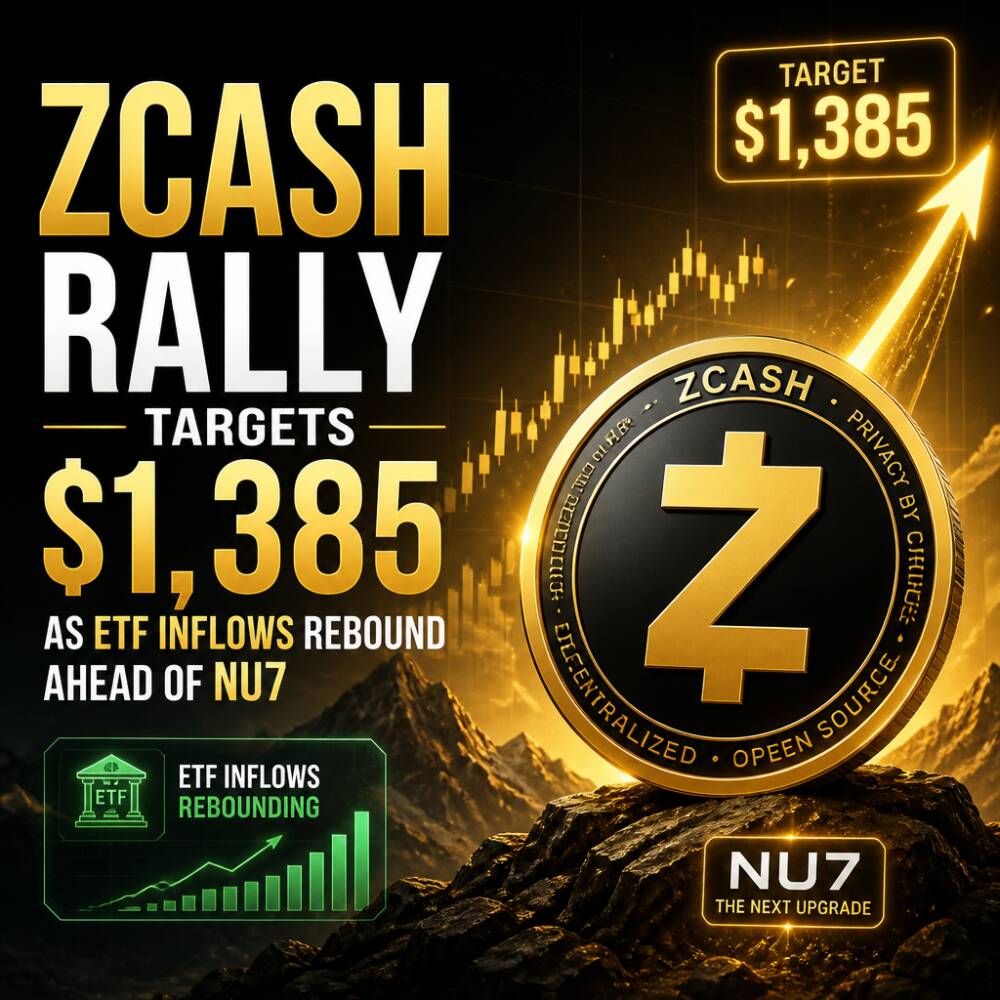
Zcash is edging higher on Monday, trading above $1,250 as investors refocus on a scheduled network upgrade and renewed debate over how the protocol funds development. The move comes alongside improved demand for Zcash-linked investment products and a modest rebound in derivatives positioning, though analysts caution the latest uptick may be more stabilizing than breakout-driven.
At last check, ZEC was around $1,253, supported by inflows into investment products and expectations for Network Upgrade 7 (NU7), set for November 5. The price action also reflects a shift toward a compromise proposal for community grant funding, which could reduce uncertainty around long-term sustainability plans.
Key takeaways
- ZEC rose to above $1,250, signaling a partial recovery from recent selling pressure.
- Catalysts include trading focus on NU7 on November 5 and a new endorsement for a compromise affecting development grant allocation.
- Implication: the market is watching whether buying can push ZEC through $1,385, the next major resistance level.
- Momentum looks neutral-to-improving, with technical indicators suggesting stability but not a confirmed bullish breakout.
What drove the move
The upgrade narrative is a central driver. According to the report, Network Upgrade 7 is expected to shorten Zcash’s block interval from 75 seconds to 25 seconds, enabling faster transaction confirmations. The upgrade will also disable the legacy Sprout pool and its transactions, an element that could influence how market participants anticipate protocol behavior post-activation.
Alongside the technical roadmap, discussion around funding has shifted. The report said Zcash Open Development Lab founder Josh Swihart now supports a compromise put forward by co-founders Sean Bowe and Zooko Wilcox-O’Hearn. The proposed change would end an 8% share of block rewards currently directed to Zcash Community Grants (ZCG) and redirect that allocation into a proposed Future Dev and Legal Defense Fund lockbox.
The report added that, under the arrangement, ZCG would contribute 50,000 ZEC to the Network Sustainability Mechanism, while existing grants would continue to be funded from its current treasury. While not described as finalized, Swihart’s endorsement is the kind of confirmation that can alter expectations ahead of major protocol milestones.
Market reaction and positioning
Demand for Zcash-linked products appears to be improving. According to figures cited from SoSoValue, these products took in $17.72 million last week after $41.09 million the week before. The report said this came after three consecutive weeks of outflows following a late-September 3-for-1 share split.
On the derivatives side, the report referenced CoinGlass data showing ZEC futures open interest at $2.54 billion, up from $2.47 billion on Sunday and $2.3 billion on Saturday. However, it remains below Tuesday’s 2.18 million ZEC, suggesting the rebound may reflect a partial recovery in positioning rather than a full return of speculative demand.
How traders are reading the chart
Technically, the report said ZEC is holding above a rising trendline drawn through the October 18 and October 30 lows, with support near $1,215. Buyers have also regained the 50-period EMA around $1,250 and the 200-period EMA near $1,240, changes that traders often interpret as a shift toward better short-term structure.
Momentum indicators are described as mixed. The report said the Relative Strength Index (RSI) sits at 50, a level associated with neutral momentum. Meanwhile, the MACD remains subdued below its signal and zero lines, which the report characterized as more consistent with improving stability than a decisive bullish breakout.
In terms of levels, the report highlighted $1,385 as the next major upside hurdle, a resistance area that has held since October 6. It also cited potential targets if ZEC can sustain moves above that level, including Fibonacci extension zones near $1,493 and $1,644, based on the decline from $1,385 to the October 18 low at $1,049.
On the downside, the report pointed to the $1,250 and $1,240 moving averages as the nearest support area. Below that, it said the trendline near $1,215 and a 50% retracement close to $1,205 could attract demand. A sustained breakdown below these zones would, according to the report, weaken the near-term recovery case.
Bigger picture: what to watch before NU7
With NU7 scheduled for November 5, near-term trading is likely to remain sensitive to protocol development headlines and any further clarification on the proposed funding shift for community grants. The market is also balancing improving product inflows against the risk that the recent buying could stall at resistance before translating into a broader trend change.
Investors may want to monitor follow-on updates as NU7 approaches, including any confirmation details that could affect expectations for network performance and the post-upgrade transaction environment. Additional movement in Zcash-linked investment product flows and futures positioning could also signal whether momentum persists or fades ahead of the upgrade date.


