

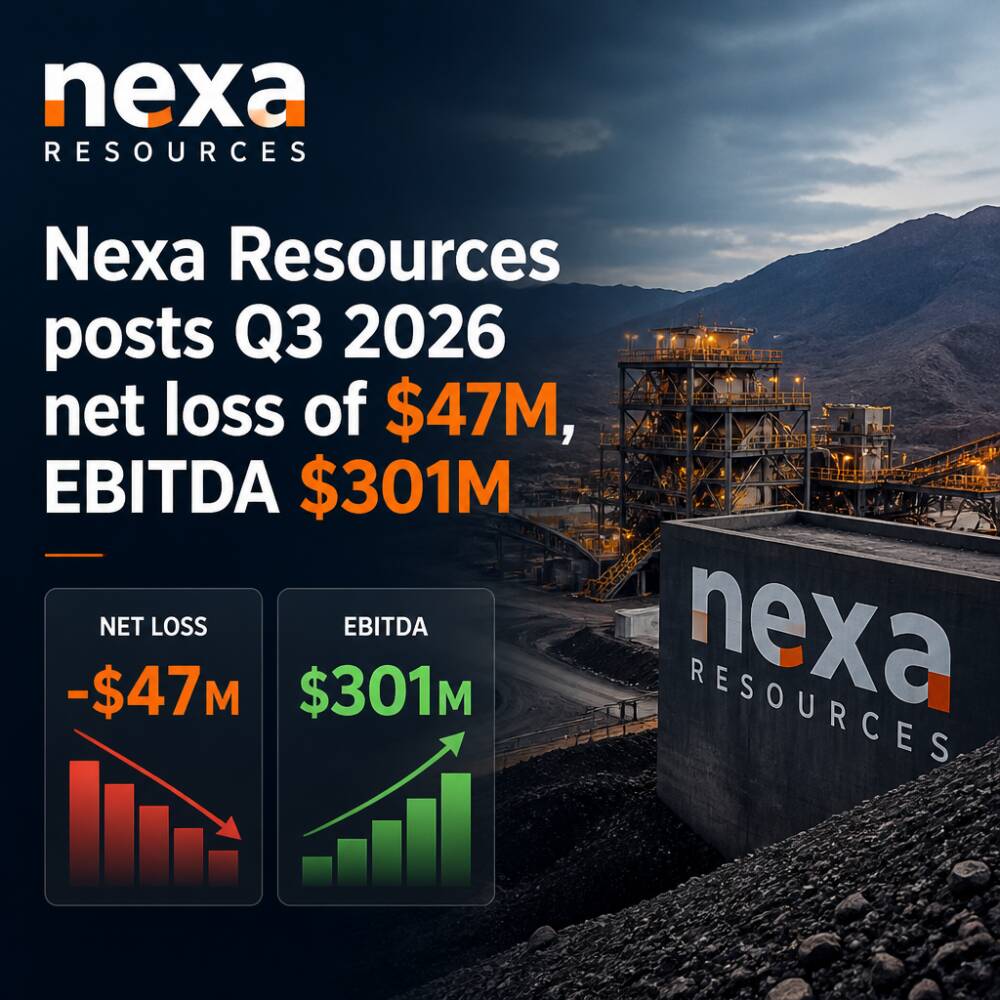
Nexa Resources reported a third-quarter 2026 turnaround in operating performance but ended the period with a substantially wider loss, driven by large non-cash charges tied to its Brazilian smelting business and adjustments related to its silver-streaming arrangements. The company said adjusted EBITDA rose 62% year over year to US$301 million, while net revenues climbed 23% to US$937 million.
The quarterly results come alongside major corporate developments: Votorantim agreed to sell its controlling stake in Nexa to Boliden, and Nexa later disclosed that a ratings downgrade will trigger a change-of-control tender offer affecting its 2028 notes. Nexa also increased its 2026 capital expenditure guidance.
Key takeaways
- Loss deepened: Nexa posted a net loss of US$47 million in the third quarter of 2026 versus net income of US$100 million a year earlier.
- Primary catalyst: A US$124 million non-cash net impairment charge on Brazilian smelting assets, plus a US$51 million silver-streaming remeasurement adjustment, weighed on earnings.
- Operating improvement: Adjusted EBITDA increased 62% to US$301 million, supported by higher zinc prices and stronger by-product contributions.
- Balance-sheet implications: A move to a new controlling owner is expected to lead to a change of control tender offer for the 2028 Notes.
- CapEx raised: Nexa lifted 2026 capital expenditure guidance to US$420 million, up 10% from US$381 million previously disclosed.
What drove the results
According to Nexa’s third-quarter 2026 financial reporting, the company’s net loss was primarily explained by two items. The first was a US$124 million non-cash net impairment charge related to its Brazilian smelting assets. The second was a US$51 million silver-streaming remeasurement adjustment, reflecting changes in the underlying assumptions used to value the streaming arrangement.
Despite the earnings decline at the net-income level, Nexa reported stronger underlying operating metrics. Adjusted EBITDA rose 62% year over year to US$301 million, the company attributed to higher zinc prices and improved contributions from by-products. Net revenues also increased, rising 23% year over year to US$937 million.
Corporate actions and debt-related requirements
On August 27, 2026, Votorantim S.A. entered into a definitive agreement to sell its 64.68% controlling stake in Nexa Resources S.A. to Boliden. Nexa said closing is expected in the first quarter of 2027.
After the deal announcement, S&P Global Ratings lowered its long-term ratings on Nexa to ‘BB+’ from ‘BBB-’, according to the company disclosure dated October 27, 2026. Nexa also said the downgrade will require it to make a change of control tender offer for the 2028 Notes within 30 days after the transaction closes. The tender offer price is set at 101% of the notes’ principal amount, with the notes’ outstanding principal amount described as approximately US$111 million as of September 30, 2026.
In investor terms, the key implication is that the change in ownership—combined with the rating action—could increase near-term cash outflow risk tied to the tender mechanism, even as operating performance improves through the commodity cycle.
CapEx guidance raised for 2026
Nexa revised its 2026 capital expenditure guidance to US$420 million, up 10% from the US$381 million previously disclosed. The company said the increase mainly reflects a broader acceleration and sequencing of projects and currency effects.
In its explanation, Nexa cited the acceleration of mine development at Aripuanã to support higher throughput in 2027. It also pointed to the bring-forward of investments in the Cerro Pasco Integration Project. Finally, Nexa attributed part of the change to the appreciation of the Brazilian real, which can lift reported spending needs when costs are incurred in local currency.
For investors, the raised capex underscores management’s intent to improve future production capacity, but it also raises attention on project execution and funding—particularly during a period when the company is navigating both impairment-related charges and a planned change in control.
What to watch next
Heading into the first quarter of 2027, Nexa’s primary catalysts are likely to be the Boliden-led ownership transition and the timing and funding of the change-of-control tender offer for the 2028 Notes. Investors may also focus on whether the company’s higher-throughput plan at Aripuanã and the accelerated Cerro Pasco integration investments translate into tangible operational gains. In the near term, attention will likely shift to subsequent quarterly updates for progress on projects, developments around the debt tender process, and the continuation of the commodity drivers behind the strong adjusted EBITDA growth.


