

Key takeaways
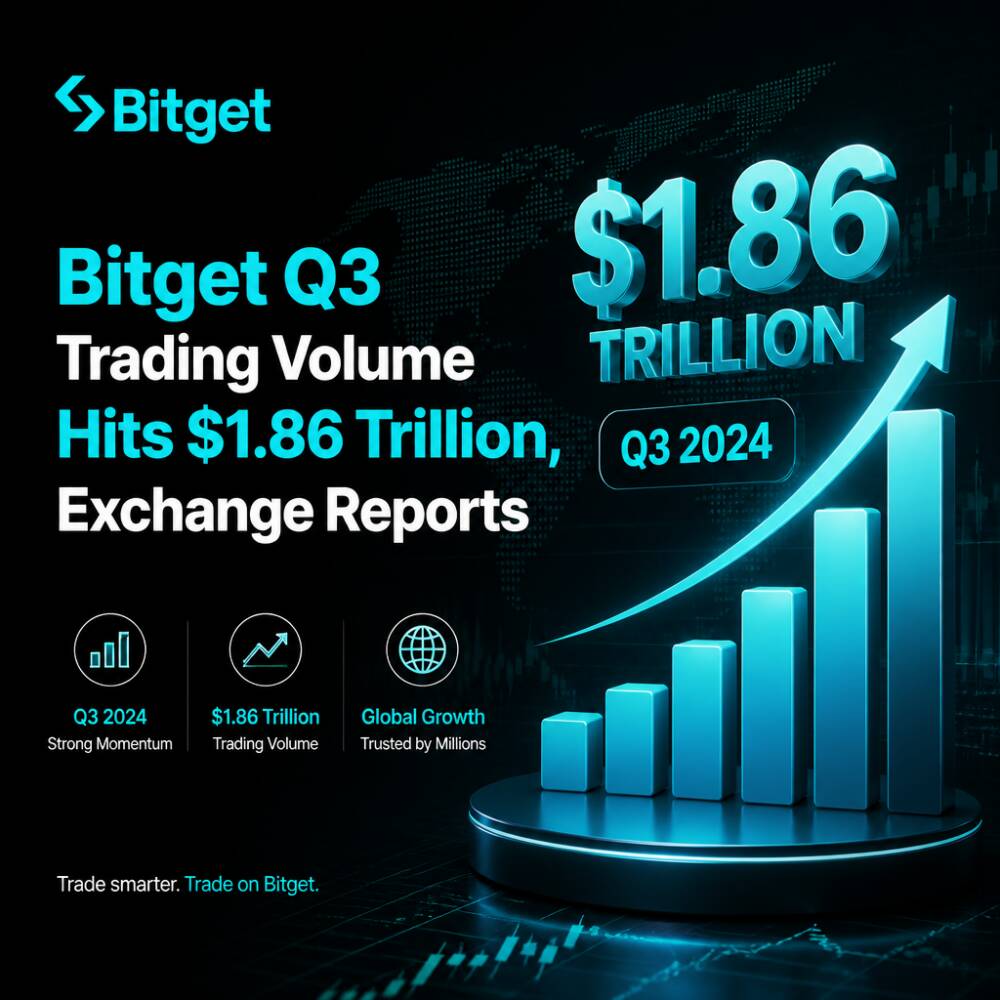
- Trading volumes climbed: Bitget reported $1.86 trillion in combined Q3 2026 trading volume, with monthly volume rising 21.2% from July to September.
- Derivatives and tokenized products led growth: Crypto derivatives volume increased 31.5% to $409.19 billion, while crypto spot rose 65.7%; CFDs expanded 39.7% to $376.32 billion for the quarter.
- Liquidity and cross-asset infrastructure were key catalysts: The launch of Cross-Asset Unified Account (UTA) expanded shared margin use across more than 370 eligible assets, including 100+ tokenized US stocks.
- Security remains a focus after an incident: After a Sept. 24 security event, Bitget said user balances were unaffected, while it brought in external firms for an investigation and increased its Protection Fund.
- Implication for investors and users: Bitget’s push toward tokenized equities and unified collateral suggests intensified competition for liquidity and cross-asset trading experiences.
Bitget said its Q3 2026 Transparency Report showed a surge in activity across crypto derivatives, spot, and non-crypto trading products, with combined trading volume totaling $1.86 trillion. The platform reported growth across major categories, supported by deeper liquidity and expanded cross-asset capabilities, while also detailing security upgrades following a Sept. 24 incident.
Data shows trading volume rose 21.2% on a monthly basis from July through September. In the quarter, crypto derivatives climbed 31.5% to $409.19 billion, crypto spot volume increased 65.7%, and CFD trading expanded 39.7%, reaching $376.32 billion—making it Bitget’s largest non-crypto category.
What drove the move
Bitget attributed part of the quarter’s expansion to improvements in liquidity and cross-asset trading access. A key milestone was the launch of Cross-Asset Unified Account (UTA), designed to bring a wider set of assets into a shared margin framework.
According to the report, UTA supports more than 370 eligible assets, including 100+ tokenized US stocks, with collateral valuation ratios of up to 95%. The company said the change allows eligible tokenized equities to be used as collateral across different trading products, aiming to give users more flexibility in capital management.
Bitget also highlighted a broader tool rollout, expanding its AI-powered trading suite by extending GetAgent Playbook to tokenized US equities. Additional product initiatives included institutional pricing upgrades and the introduction of Cash Plus, described as a yield-generating stablecoin offering.
In a statement, Bitget CEO Gracy Chen said the firm is seeing more traders move between crypto, stocks, and traditional assets, which is part of why it is building a “Universal Exchange.” Chen also said Q3 growth came with a renewed focus on protecting users as the platform expands.
Market reaction and liquidity metrics
The report also included third-party liquidity assessments and benchmarking across crypto and tokenized equity trading. Independent research cited by Bitget pointed to stronger order-book depth and tighter execution conditions relative to peers.
TokenInsight, according to the report, ranked Bitget first among nine exchanges for combined BTC and ETH futures depth within 0.05% of market price, recording $41.6 million in liquidity. CoinGecko also placed Bitget among leading exchanges for BTC and ETH spot liquidity.
For tokenized equities, CryptoRank said Bitget’s Reality venue showed up to 58% lower simulated slippage on $50,000 orders than the next-lowest comparable venue. DeFiLlama, the report said, measured a median bid-ask spread of 0.83 basis points and found the deepest top-of-book liquidity across five markets evaluated.
While these findings do not explain day-to-day price moves for external markets, they help frame why users may have increased activity: tighter liquidity conditions typically reduce execution costs and improve the consistency of fills—factors that matter to both retail traders and institutions moving across asset classes.
Security steps after the Sept. 24 incident
Beyond growth, Bitget’s Q3 report also addressed the aftermath of a security incident on Sept. 24. The company said it implemented containment and recovery measures and that users’ account balances remained unaffected.
Bitget said it engaged Mandiant and SlowMist to support an independent investigation. The firm also reported replenishing its Protection Fund to more than $300 million by Sept. 30, ahead of its original commitment.
The report further said Bitget strengthened security infrastructure by introducing a circuit breaker mechanism, receiving an independent assessment from SlowMist, and increasing its security budget. Bitget also stated it maintained a Proof of Reserves ratio above 110%.
Security-focused updates are particularly relevant for investor and user confidence in exchanges that handle cross-asset collateral, since expanding tokenized products can broaden the operational and risk surface area.
Bigger picture: cross-asset competition
Bitget’s Q3 disclosure reflects a broader industry push toward cross-asset trading, where crypto exchanges increasingly seek to integrate tokenized equities and traditional-style margin structures. By enabling tokenized stocks to act as collateral across multiple trading products, Bitget is positioning its platform to attract users who want one framework for managing risk and liquidity across categories.
The reported expansion in CFD trading also suggests demand for non-crypto derivatives and structured exposure alongside spot and perpetual-style activity. Combined with liquidity benchmarking and new trading tools, Bitget’s strategy appears geared toward improving execution quality while broadening asset access.
Looking ahead, market participants will likely watch whether Bitget sustains cross-asset volume momentum, how its unified collateral model performs under stress conditions, and whether additional security developments follow the post-incident upgrades. Investors and users may also monitor upcoming exchange disclosures tied to platform performance, liquidity, and risk controls.


