

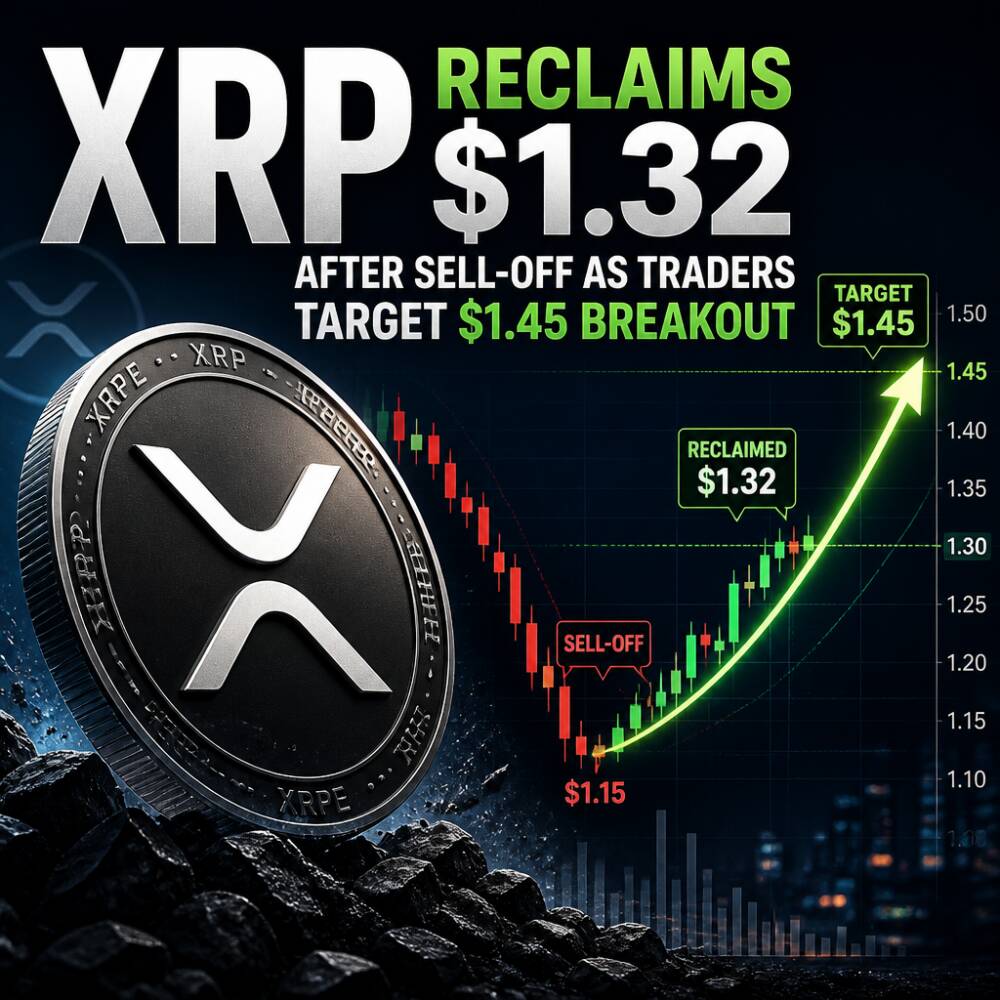
XRP rebounded toward $1.34 after dipping briefly below $1.32, as stronger-than-expected U.S. producer inflation data rattled cryptocurrency markets. The token fell nearly 6% on Thursday before stabilizing near a widely watched support zone, limiting the damage, though traders’ broader technical outlook remained cautious.
Investors are now focused on whether XRP can hold above $1.32. A clean reclaim would point to stabilization, while another breakdown could pull attention back toward $1.25.
Key takeaways
- Price move: XRP slipped to just under $1.32 before rebounding toward $1.34, following a near 6% drop on Thursday.
- Catalyst: September U.S. Producer Price Index came in hotter than expected, pressuring risk sentiment in crypto.
- Key implication: Holding above $1.32 is critical to sustaining the recovery; losing it increases the risk of a revisit to $1.25.
- Next threshold: A sustained move above $1.45 would strengthen the case for a broader trend shift.
What drove the move
U.S. inflation data landed above expectations. According to the September Producer Price Index, prices rose 1.3% month over month, exceeding analyst expectations of 0.5%. Core PPI—excluding food and energy—also accelerated to 0.7% versus a forecast of 0.3%, and represented a 0.5 percentage-point increase from the prior month.
The release followed a hotter-than-expected Consumer Price Index earlier, reinforcing concerns about persistent inflation and what that could mean for Federal Reserve policy. While the PPI initially weighed on cryptocurrencies, XRP’s subsequent rebound suggested buyers were willing to step in around recent support levels rather than continue selling indiscriminately.
Market plumbing also likely amplified the volatility. Data compiled by CoinGlass indicated roughly $1.7 billion in cryptocurrency liquidations over four days. The report pointed to a developing long squeeze, where falling prices triggered forced closures of leveraged bullish positions. After the selloff, that reversal dynamics appears to have flipped again for traders positioned for further losses, with more than $300 million in short positions liquidated over the last 24 hours.
Those liquidation totals cover the wider crypto market rather than XRP alone, but they help explain why price moves can quickly overshoot in both directions when leverage is concentrated.
Market reaction beyond the token price
Despite the rebound, demand tied to XRP exchange-traded products remained muted. According to SoSoValue data, XRP-linked ETFs recorded about $13 million in net inflows so far in October. At that pace, the products would land around $26 million for the month, which would represent a roughly 79% decline versus September.
Weak inflow trends can matter for medium-term sentiment because ETFs often serve as a channel for incremental investor participation. Without stronger net purchases, the rebound may be more dependent on spot buyers defending key technical levels rather than sustained new capital flows.
On-chain activity offered a more mixed read. Santiment data showed XRP transfers into exchanges have declined after a noticeable increase between September 10 and September 27. Lower exchange inflows can be interpreted as reduced near-term supply headed to trading venues—potentially easing selling pressure—though the metric does not confirm whether tokens are destined for liquidation, and it does not fully rule out other forms of selling pressure.
Technical levels traders are watching
The $1.32 area has become the central line for XRP’s near-term direction. The rebound toward $1.34 shows the market reacted positively to support defense, but the ability to sustain gains depends on whether buyers can hold that level on follow-through trading.
Upside pressure could build if XRP clears resistance decisively, including by pressuring remaining short positioning. However, a larger short squeeze would require both favorable positioning and continued buying momentum rather than a single rebound candle.
Beyond $1.32, the more consequential threshold highlighted in the market analysis is $1.45. A sustained break above $1.45 would strengthen the argument that the decline is transitioning into a broader trend change, not just a temporary oversold bounce.
Traders also continue to view $1.25 as the key downside reference point. If XRP falls back below $1.32, the near-term setup weakens and the probability of a retest of $1.25 increases. The longer-term $1.80 target is framed as a bullish scenario rather than an immediate expectation.
Bigger picture: inflation, leverage, and flow signals
For crypto, the interplay between macro data and leverage remains a dominant factor. Hotter-than-expected PPI reinforces a challenging rate and inflation backdrop, which can pressure speculative assets. At the same time, liquidation-driven reversals show how quickly crowded positions can unwind during fast market moves.
For investors looking for confirmation beyond price action, ETF inflows and exchange-flow trends provide additional context. Limited ETF net inflows suggest the rebound is not yet being broadly supported through traditional investment channels, while declining exchange transfers may point to a gradual reduction in immediate sell-side pressure—if it continues alongside price stability.
Next, traders will likely watch whether XRP can hold above $1.32 and whether it can challenge resistance toward $1.45. Additional U.S. inflation and Federal Reserve-related data will remain important for broader risk appetite, while follow-up signals from ETF flows and on-chain exchange activity could help determine whether the recovery is stabilizing or fading.


