

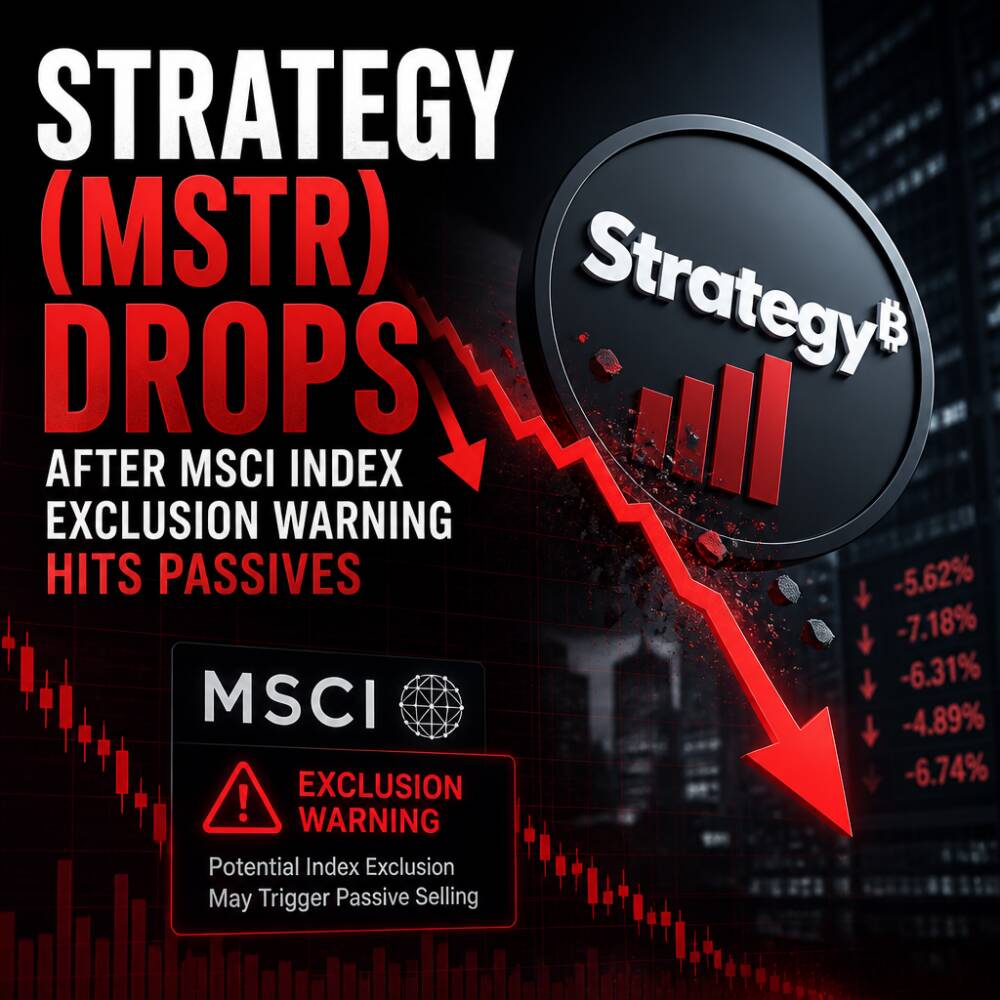
Strategy shares fell on Friday as investors weighed a potential change to MSCI index rules that could exclude non-operating companies from key global benchmarks, even as Bitcoin rose. The stock dropped 6% while Bitcoin traded around $82,290, up more than 1.3% over the prior 24 hours, underscoring that index and financing considerations are shaping sentiment toward the world’s largest publicly listed corporate Bitcoin holder.
The company also reiterated plans related to its STRC preferred stock, declaring that it will maintain a 12% annualised dividend rate for November, subject to shareholder approval and the timing of related amendments.
Key takeaways
- Price move: Strategy shares fell about 6% on Friday despite a rise in Bitcoin.
- Catalyst: MSCI’s announcement that non-operating companies could be removed from its Global Investable Market Indexes after November 30.
- Key implication: Passive funds tracking MSCI benchmarks may be required to reduce or exit positions, creating potential selling pressure.
- Company action: The board declared November dividends on its STRC preferred stock, keeping the annualised rate at 12% (subject to approval).
What drove the move
MSC I said on Thursday that non-operating companies would be ineligible for inclusion in its Global Investable Market Indexes starting from the close of November 30. MSCI plans to publish the final list of affected companies on November 11.
Strategy, formerly known as MicroStrategy, is among the companies that could be impacted, alongside Japan’s Metaplanet. Other cryptocurrency treasury companies, including SharpLink, are also reportedly under watch for potential exclusion.
MSCI’s policy follows a review it began last year on whether digital asset treasury companies should be treated similarly to investment funds, which are already excluded from its indexes. MSCI deferred an earlier proposal in January, then expanded the review to cover non-operating companies more broadly.
For Strategy, the index decision matters because passive investment vehicles designed to track MSCI benchmarks generally must hold constituents. The company has previously warned that removal from such indexes could lead to approximately $2.8 billion of its shares being liquidated.
Strategy has disputed MSCI’s classification approach. In a statement on Friday, the company said it believes MSCI’s proposal is “misguided.” Strategy also argued that the operating versus non-operating distinction is undefined and not grounded in commonly recognised accounting or legal frameworks, including US GAAP and IFRS.
At the same time, Strategy said funds tracking MSCI’s Global Investable Market Indexes hold only 3.1% of its outstanding shares, which it suggested could limit the direct impact of an exclusion.
Market reaction and what investors are likely watching
The selloff despite higher Bitcoin prices suggests investors are focusing less on near-term cryptocurrency performance and more on how equity market mechanics could affect Strategy’s share supply and demand. If index-tracking funds are forced to rebalance, the resulting sell pressure could occur independently of Bitcoin’s direction.
The potential timeline also adds another layer of uncertainty. MSCI’s final affected-company list is expected on November 11, with the rule taking effect after November 30, leaving investors to price the probability and timing of any exclusion.
Investors will also likely monitor Strategy’s attempt to offset index-related risk with capital instruments linked to its Bitcoin strategy. STRC preferred stock is part of the company’s financing structure and may influence trading interest if dividend expectations remain stable.
Strategy maintains its STRC dividend plan
Separately, Strategy announced plans to maintain a 12% annualised dividend rate on its STRC preferred stock for November, subject to shareholder approval and the effectiveness of related amendments.
The board declared daily cash dividends for each calendar day in November, with payments scheduled to begin on November 2. Each dividend is payable on the business day following its record date, according to a regulatory filing.
Strategy said management will continue recommending the 12% rate until STRC shows “sustained, healthy trading near $100 per share.”
STRC is described as a key fundraising instrument used to support Bitcoin purchases. The company’s capital framework also allows it to sell Bitcoin to fund dividend payments, which may be intended to make the preferred stock more attractive to investors and help anchor trading around its $100 par value.
In Friday’s session, STRC was down 0.2% at $99.33.
Bigger picture: financing conditions and index risk
Strategy’s business model depends on raising capital through equity and debt markets to acquire Bitcoin. That structure has made the stock a high-sensitivity vehicle for corporate cryptocurrency exposure, but it also leaves it vulnerable to changes in funding conditions and market infrastructure—such as index inclusion rules.
While Bitcoin strength can support sentiment, Friday’s move suggests that equity investors are weighing non-crypto factors that may determine how much forced selling could occur from benchmark reconstitutions. With MSCI set to finalize its affected list in mid-November, the next key catalyst for Strategy shareholders may be clarity on whether it is classified as a non-operating treasury company under MSCI’s framework.
Investors will likely watch MSCI’s November 11 announcement, any updates to Strategy’s engagement with the index provider, and ongoing trading in STRC as the November dividend period approaches. Strategy’s next steps around its capital framework and preferred stock support may also come under closer scrutiny as the market attempts to gauge the balance between Bitcoin-driven upside and equity-market-specific risks.


