

Semiconductor-focused exchange-traded funds continue to draw attention as investors position for artificial intelligence infrastructure demand. The iShares Semiconductor ETF, which tracks a basket of chipmakers and related hardware, has benefited from the strong performance of its biggest AI beneficiaries, though market observers warn that the group’s recent rally leaves room for heightened volatility.
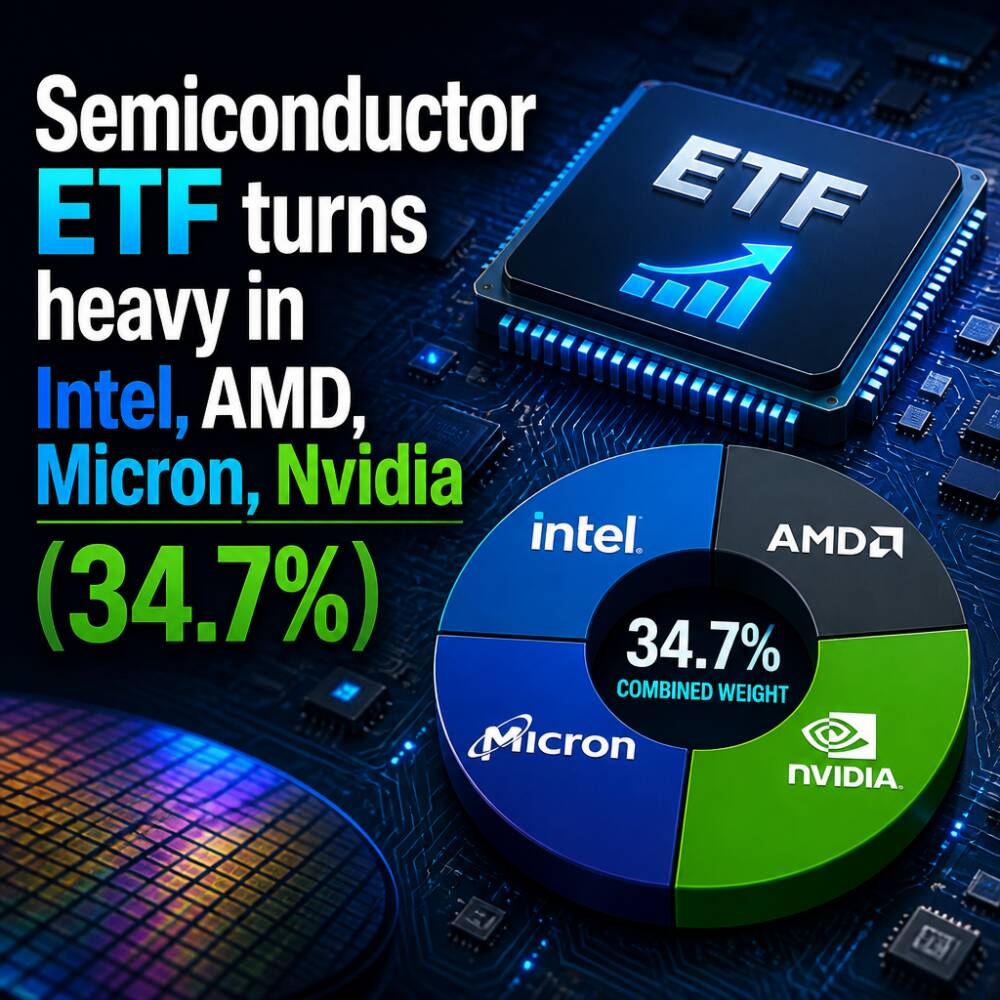
With assets concentrated in a handful of large names—most notably Intel, Advanced Micro Devices, Micron Technology, and Nvidia—the ETF’s returns have closely tracked the fortunes of AI-related compute and memory supply chains. Data in the article notes that the fund has generated a 90% year-to-date return, underscoring how sharply investors have leaned into the AI hardware buildout.
Key takeaways
- Price move: The iShares Semiconductor ETF has posted a 90% year-to-date return, reflecting strong demand for AI-linked semiconductor exposure.
- Catalyst: Investor enthusiasm for AI data center hardware has lifted key holdings, led by Nvidia and supplemented by AMD, Micron, and Intel.
- Concentration risk: More than one-third of the ETF’s assets are in its top four positions, making results sensitive to moves in a few stocks.
- Near-term implication: The article cautions that returns have likely outpaced what investors should expect to sustain in the near term, which could translate into volatility.
What the iShares Semiconductor ETF is built to own
The iShares Semiconductor ETF is designed to invest in companies that design, manufacture, and distribute semiconductor chips and components, with particular exposure to businesses tied to the AI segment. While the fund holds 30 semiconductor stocks, the balance is heavily tilted toward its largest holdings.
According to the article, the fund’s top four positions account for a substantial share of assets: Intel (9.86%), Advanced Micro Devices (9.48%), Micron Technology (7.90%), and Nvidia (7.47%). The article states these weightings are accurate as of Sept. 21, 2026, and may change over time.
This structure means the ETF behaves less like a broad market proxy for semiconductors and more like a concentrated vehicle for AI compute and its enabling components, particularly for data center workloads where GPUs and high-bandwidth memory are critical.
Why AI hardware demand matters for the fund
The article frames AI as a key driver of semiconductor demand over the coming years, pointing to the way chip ecosystems support training and inference in data centers. It highlights that NVIDIA and AMD supply GPUs favored for large-scale AI workloads, while Micron is positioned as an important supplier of high-bandwidth memory (HBM), a component that helps keep data moving to processors efficiently.
In addition to the top four holdings, the article notes that the ETF also includes other prominent infrastructure beneficiaries. These include Broadcom, which designs AI data center chips; SK Hynix, another HBM supplier; and Taiwan Semiconductor Manufacturing, which manufactures chips for Nvidia, AMD, and other semiconductor companies.
Intel is described as pursuing both data center and personal computer pathways for AI. The article says Intel has expanded into the AI segment with data center accelerators such as its Gaudi series and also launched Core Ultra processors intended to run some AI workloads locally—an approach that could matter if more AI inference shifts toward edge and client devices. However, the article also notes that Intel still lags rivals in the data center GPU market.
Market reaction and what investors may infer
The article attributes recent strength in the ETF to the outsized performance of its largest holdings during the AI upcycle. It states that blistering returns in those stocks during 2026 helped power the fund’s 90% year-to-date gain.
From an investor standpoint, that concentration can amplify both upside and downside. When AI hardware leaders rally, the ETF can move sharply higher; when expectations for product cycles, margins, or demand growth cool, the fund’s performance can compress quickly because a few names dominate the basket.
The article also contrasts the ETF’s longer-term track record with the conditions that have fueled the current surge. It states that the fund has delivered 14.2% compound annual returns since launch in 2001, beating the S&P 500’s roughly 9% annual average over the same period. Still, it argues that the returns investors are seeing now are being boosted by market dynamics that may not persist.
Bigger picture: margin pressure as supply normalizes
A central caution in the article is that semiconductor earnings may face pressure as supply constraints ease. It says many semiconductor companies are currently reporting inflated profit margins because global supply shortages have enabled pricing power, but that additional manufacturing capacity coming online could reduce margins and, in turn, weigh on earnings over the next couple of years.
That view implies a potential shift in the market’s near-term driver from “scarcity-fueled” profitability toward more typical competitive pricing and production dynamics. In such a backdrop, performance dispersion among individual chipmakers becomes more likely—again reinforcing the importance of the ETF’s top-heavy weighting.
The article’s practical takeaway is that investors should consider using the ETF as part of a diversified portfolio rather than a standalone allocation, particularly given the probability of volatility tied to the AI cycle and the semiconductor supply chain.
Looking ahead, investors will likely focus on semiconductor demand signals tied to AI buildouts, updates on memory supply and pricing, and evidence on whether margins can hold as capacity expands. Upcoming catalysts for the broader sector typically include quarterly earnings from major holdings and macro data that influences interest-rate expectations, which can affect valuations for high-growth technology stocks.


