

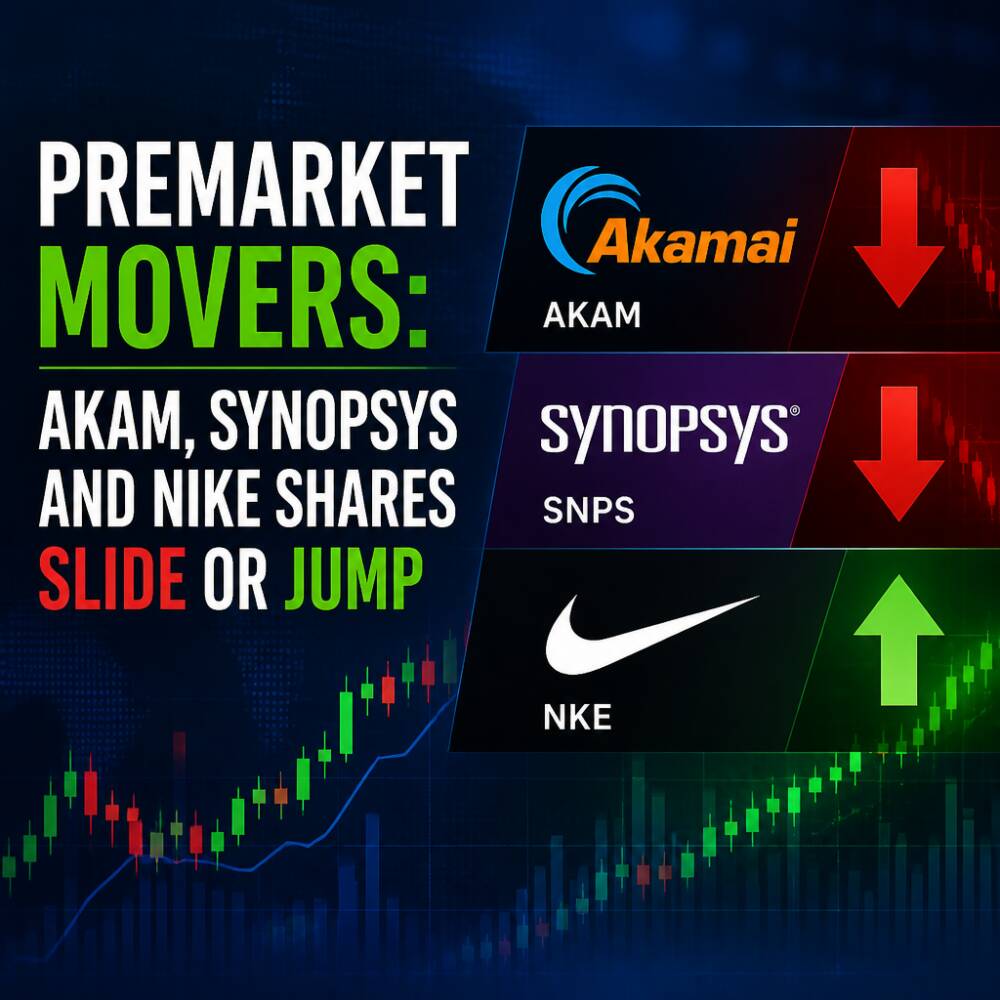
Stocks in premarket trading saw sharp swings across several names, driven by a mix of deal news, earnings results, analyst upgrades and downgrades. Akamai surged after announcing a multi-year power contract and a large agreement tied to Anthropic, while Scholastic slid following a fiscal first-quarter loss and declining revenue. Synopsys rose after an HSBC upgrade, and Nike fell after Bank of America cut its rating and flagged expectations for weaker sales. Costco edged lower despite beating expectations in its fiscal fourth-quarter report.
Key takeaways
- Akamai shares jumped more than 21%: The move followed a seven-year power contract and an $11.6 billion deal with Anthropic, plus a warrant tied to an equity purchase option.
- Scholastic fell over 10%: The publisher reported an adjusted loss in its fiscal first quarter and revenue that declined year over year.
- Synopsys gained over 3%: HSBC upgraded the stock to buy, citing a new business model positioned as a beneficiary of AI growth.
- Nike dropped nearly 2%: Bank of America downgraded the company to underperform and pointed to expected sales declines beginning in the second quarter and continuing through fiscal 2027.
- Costco slipped slightly: Results exceeded analyst expectations, but the shares moved marginally lower in premarket trading.
What drove the biggest moves
Akamai Technologies: surge on deal and power agreement drove the most dramatic premarket reaction. The cloud computing company jumped more than 21% after it announced a seven-year power contract and an $11.6 billion deal with Anthropic. Akamai also issued a warrant that gives Anthropic the right to buy up to roughly 5% of Akamai’s shares at an exercise price of $111.33 each. Investors appeared to focus on the scale of the Anthropic agreement and the strategic tie-up implied by the equity warrant structure.
Scholastic: earnings pressure outweighed revenue stabilization sent the children’s book publisher lower by more than 10% in premarket trade. The company posted an adjusted loss of $3.63 per share in its fiscal first quarter, compared with an adjusted loss of $2.52 per share a year earlier. Revenue came in at $216.8 million, down 4% from the year-ago period. The combination of worsening losses and a modest revenue decline likely drove the selloff, as investors looked for evidence of improvement in profitability.
Synopsys: upgrade fueled optimism around AI-linked growth supported a gain of more than 3% for the software company. HSBC upgraded Synopsys to buy from hold, with Frank Lee arguing that the firm’s new business model would make Synopsys a “high-growth AI beneficiary.” The upgrade suggests investors were willing to reprice the stock based on an interpretation that Synopsys can capture incremental demand tied to AI infrastructure and software tooling.
Nike: downgrade reflected concerns about the sales trajectory weighed on the athletic apparel maker. Shares fell nearly 2% after Bank of America downgraded Nike to underperform from neutral. The bank said it expects sales declines from the second quarter through the rest of fiscal 2027, pointing to a longer stretch of softer demand assumptions than investors were previously modeling. A multi-year downgrade can be particularly impactful if it changes expectations for revenue growth and margin outlook over time.
Costco Wholesale: results beat expectations, shares modestly lower even though the retailer reported stronger performance. Costco posted an adjusted $6.60 per share on revenue of $95.72 billion for its fiscal fourth quarter. Analysts polled by LSEG expected profit of $6.53 per share on revenue of $94.86 billion. Despite the beat, shares were down slightly in premarket trading, implying investors may have been looking for additional signals such as stronger guidance, operating trends, or forward commentary not reflected in the summary figures.
Market reaction and what investors likely took from it
Akamai’s move stood out as investors reacted to a large, contract-driven news flow. For cloud and enterprise software providers, deal announcements can quickly shift expectations for revenue visibility. The inclusion of an equity warrant tied to Anthropic also added a governance and strategic component that market participants may view as aligning incentives while creating a potential future capital plan for Akamai.
For Scholastic, the market response was more straightforward: a larger adjusted loss and lower revenue were a double negative. When results disappoint on both earnings and sales, investors often focus on cost control and whether management can stabilize margins in subsequent quarters.
Synopsys gained on a sell-side catalyst rather than company-specific results. Upgrades like HSBC’s typically reflect a reassessment of growth durability and competitive positioning. In this case, the “AI beneficiary” framing suggests investors are monitoring how software platforms monetize demand for AI-related design and verification tools.
Nike’s decline reflected downside revisions to the path of growth. Downgrades tied to multi-year sales expectations can be especially influential because they affect not just near-term estimates but also the market’s view of the company’s ability to recover growth momentum.
Costco’s slight decline despite beating consensus expectations highlights that premarket price action may still hinge on forward-looking factors. Even with a top- and bottom-line beat, markets can react negatively if investors interpret the broader outlook as only marginally supportive or if expectations were already set for a strong quarter.
What to watch next
With several catalysts centered on earnings and analyst revisions, investors should watch for follow-through in guidance and strategy commentary—especially for companies with forward-looking uncertainty such as Nike. For deal-linked stories like Akamai, attention will likely turn to how management frames implementation timelines and the expected financial contribution of the Anthropic agreement and the power contract. For Scholastic, the focus will be on signs of stabilization in profitability and whether revenue trends improve in upcoming quarters. Synopsys traders will likely monitor further details on the new business model and any evidence of AI-driven demand, while Costco investors may seek confirmation that the quarter’s results translate into sustained momentum.


