

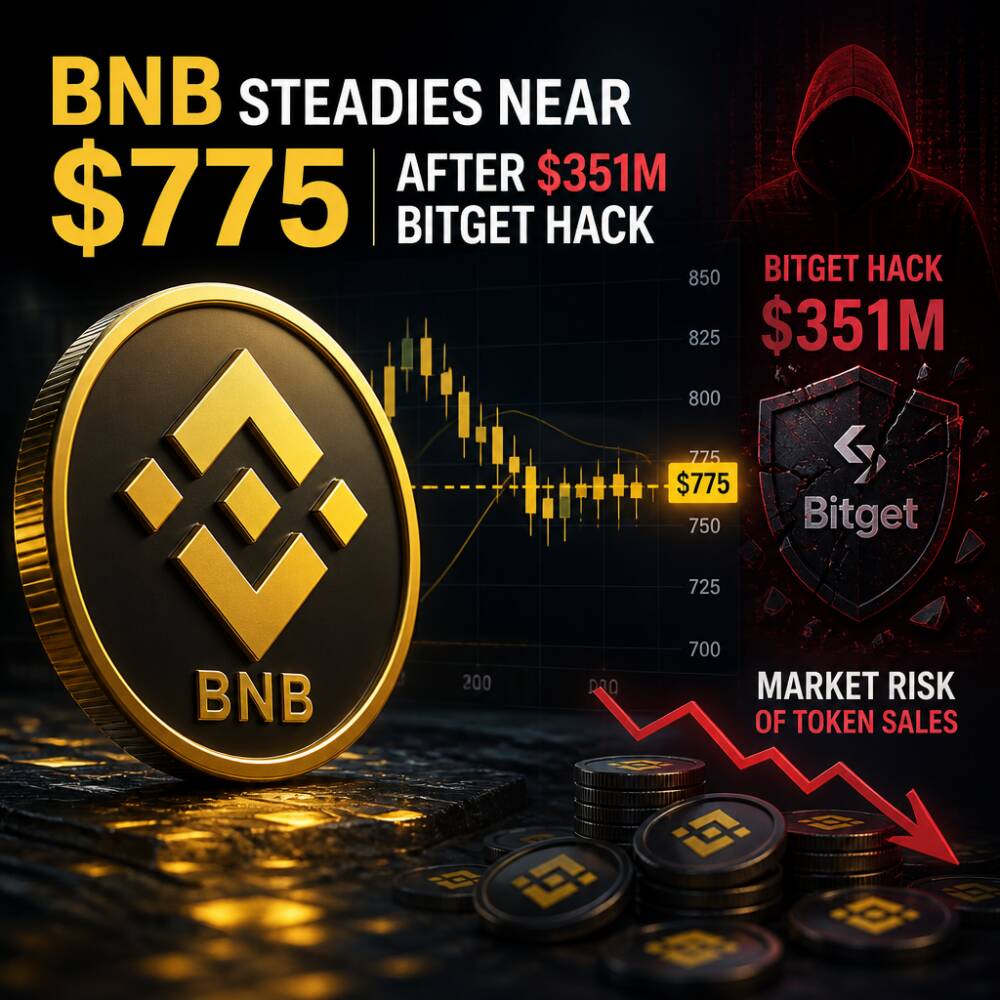
BNB held near $775 on Sept. 25 even after Bitget disclosed a hack that affected an estimated $351.6 million from certain hot-wallet holdings, adding a fresh supply risk for the market. The token was little changed on the day, trading around $775, and remains below its recent $800 peak, where buyers have struggled to reassert control.
Bitget said it detected unauthorised transfers from portions of its hot wallets at 18:31 UTC on Sept. 24. The exchange said cold wallets were secure and that user losses would be covered by its $464 million protection fund. However, the incident has renewed attention on whether stolen BNB will be swapped on-chain and potentially moved to exchanges or liquidity venues.
Key takeaways
- Price move: BNB traded near $775, steady over 24 hours and up roughly 2.5% over seven days.
- Catalyst: Bitget confirmed an estimated $351.6 million breach tied to hot-wallet transfers on Sept. 24.
- Key implication: Ongoing uncertainty around how quickly stolen assets may reach tradable markets could limit upside while BNB stays under $800.
- Market levels to watch: Support is focused around $748–$750; a deeper downside path could extend toward $720 and then $705.
What drove the move
The immediate headline catalyst was Bitget’s disclosure of unauthorised transfers tied to portions of its hot-wallet infrastructure. According to the exchange, the affected funds were estimated at $351.6 million, while cold wallets remained secure and losses were intended to be covered by a protection fund worth $464 million.
Still, the market reaction has been shaped less by the hack itself and more by how stolen funds might be handled once they surface on-chain. The report said that addresses receiving stolen assets have conducted on-chain swaps, leaving traders monitoring whether further BNB controlled by the attacker continues to flow toward exchanges or decentralised markets.
Importantly, price action suggested selling began before Bitget’s breach became public. BNB slipped below $760 on Sept. 24 before recovering toward the $780 area, indicating the token was already correcting from its push above $800 earlier in the week.
Market reaction and technical picture
BNB’s trading range since the incident has remained contained, holding between the Sept. 24 low and roughly the $780 region. That pattern suggests the initial supply shock has not been sufficient to break the token’s recent support zone.
Technical levels point to a market that remains structurally firm but is losing momentum. Data cited in the article shows BNB trading around $776 above major moving averages: the 20-day exponential moving average near $748.77, the 50-day EMA around $704.85, the 100-day EMA near $670.55, and the 200-day EMA around $669.58. The 20-day EMA has climbed above longer averages and is described as the closest dynamic support.
On that framework, the $748–$750 area is viewed as an important downside threshold. A daily close below $748 would place the recent breakout structure under pressure and could open risk toward the next support near $720. If selling continues, the article notes that the 50-day EMA near $705 could become a likely target.
Momentum indicators were also described as weakening. Chaikin Money Flow reportedly fell from above 0.20 earlier in September to around zero, implying the buying pressure that supported the rally toward $800 has faded. In addition, the 4-hour directional movement reading showed only a modest advantage for buyers (+DI at 20.52 versus -DI at 18.76), while ADX dropped to 18.75 from levels near 40 earlier in the month—consistent with a sideways market between roughly $760 and $800.
For downside follow-through, the article suggests -DI would need to move above +DI and ADX would need to rise back above 20. A break below $760 would then expose the daily 20 EMA near $749, followed by $720 and $705.
Network activity and broader context
While the hack raised near-term uncertainty, the article highlights activity on BNB Chain that may be supportive on the margin. It cited figures that total value locked reached roughly $5.8 billion during the week ending Sept. 6, while decentralised exchange volume rose to $9.21 billion.
Operational and infrastructure developments were also mentioned. The article said BNB Smart Chain has been operating under its Pasteur upgrade since Aug. 25. It further reported that BidBlock V2 accounted for roughly 98% of blocks in a latest three-day observation window and that it carried 28% more gas per block on average compared with the previous Bid V1 system.
On the applications side, the report pointed to growth in tokenised assets. It referenced figures attributed to RWA.xyz via OpenEden, stating real-world asset value on the network rose from $509.72 million in September 2025 to roughly $5.69 billion this month. It also noted that OpenEden brought TBILL and HYBOND fixed income products to BNB Chain on Sept. 17, and that US investors have had access to regulated BNB exposure through VanEck’s BNB ETF since May.
Even so, the market’s immediate focus remains on whether the hack-related uncertainty turns into actual incremental sell pressure. The risk scenario outlined is not just more BNB being stolen, but a larger portion of it reaching exchanges or decentralised venues while BNB is still trading below $800.
What to watch next: Traders are likely to monitor further on-chain movements from addresses associated with the hack, especially any steps that translate into additional sell orders. Near term, technical follow-through matters: confirmation of strength would require sustained trading above the $780 to $800 resistance zone, while a breakdown below $760 could accelerate moves toward the $748–$750 support. Investors will also look for any updates from exchanges and BNB Chain participants as the post-incident supply question evolves.


