

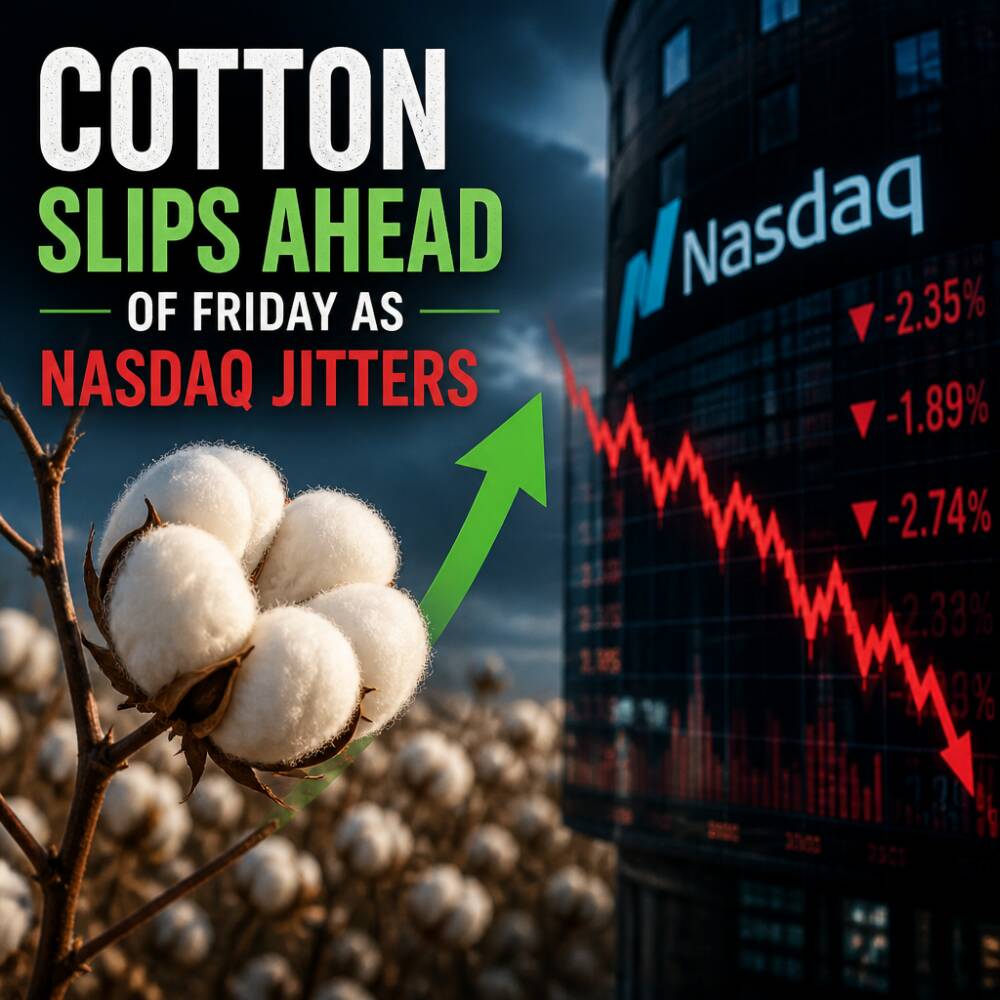
Cotton futures finished Friday’s session with a mixed tone across the curve, as the nearby contracts retreated while deferred maturities held up. At the same time, crude oil slid and the U.S. dollar index weakened, a combination traders often monitor for its influence on agricultural input costs and export competitiveness.
Limited fresh detail emerged on U.S.–China discussions during the week, with reports indicating USTR Greer was seeking the release of more information on Monday.
Key takeaways
- Price move: October cotton closed down 60 points, while December settled 60 points lower; March ended 57 points down.
- Catalyst: A lack of concrete updates on U.S.–China talks, alongside broader commodity/macro signals, pressured nearby prices.
- Curve implication: Front months fell 51 to 60 points, but deferred contracts rose 8 to 11 points, suggesting traders were more cautious in the near term.
- Weekly context: December cotton posted a 156-point gain over the week, despite Friday’s decline.
What drove the move
Friday’s cotton action reflected a tug-of-war between near-term demand expectations and lingering uncertainty around trade policy. While cotton has been sensitive to global buyer confidence, Friday brought little incremental information about what was discussed between U.S. and Chinese leadership. Reports instead pointed to the possibility of additional details being released later, with USTR Greer reportedly looking for Monday disclosures.
Meanwhile, macro inputs also leaned on sentiment. Crude oil fell $2.17 per barrel on the session, and the U.S. dollar index dropped $0.253. For cotton markets, a weaker dollar can support export flows by making U.S. cotton relatively cheaper for overseas buyers, but the overall risk tone can still weigh on futures—particularly in the front months where near-term positioning and demand expectations tend to dominate.
Positioning and export signals
Trading sentiment was further shaped by positioning data from the CFTC. The managed money category reduced exposure, cutting 16,293 contracts from its net long position in the week of September 22. After the reduction, managed money’s net long position stood at 81,610 contracts. Such trimming can reflect either profit-taking or a more cautious outlook into upcoming reports and policy developments.
On the fundamental side, the USDA Export Sales report showed export commitments totaling 4.735 million RB. That figure was 17% above the same time last year, but it also represented 41% of the USDA export projection and trailed the 49% average pace. The split between year-over-year strength and slower progress versus the USDA roadmap suggested investors may be balancing optimism on demand growth with concerns about how quickly sales are translating into scheduled export momentum.
Cash and futures benchmarks
Additional cotton market details remained mixed. The Seam reported sales of 164 bales on Thursday at an average of 78.01 cents per pound. The Cotlook A index was steady on September 24 at 93.25, and ICE certified cotton stocks were unchanged on September 24, at 29,556 bales.
From a pricing perspective, the Adjusted World Price fell 283 points on Thursday to 66.09 cents per pound, adding a downward signal that can influence how traders calibrate values across delivery months.
Market reaction and curve dynamics
Across Friday’s settlements, the nearby end of the curve underperformed. October cotton closed at 78.91, down 60 points, while December settled at 82.71, also down 60 points. March cotton finished at 85.49, down 57 points. On a broader curve basis, front months were lower by 51 to 60 points, while deferred contracts increased by 8 to 11 points.
This pattern matters for how investors read risk. A weaker nearby tone alongside firmer deferreds can indicate that traders expect supply or demand fundamentals to improve later, or that deferred months are being supported by longer-dated hedging and positioning rather than immediate near-term buying interest.
Even with Friday’s declines, the week’s performance showed resilience in parts of the curve: December cotton finished the week up 156 points, underscoring that dips may be occurring within a broader trend rather than marking a full reversal.
Bigger picture
With limited information on U.S.–China discussions, cotton markets are likely to remain sensitive to any concrete policy updates and to the flow of export and supply data. At the same time, the commodity complex’s macro backdrop—especially the direction of oil and the dollar—can continue to influence sentiment around agricultural commodities and competitiveness in export markets.
Investors will be watching for what additional details emerge from USTR Greer’s reported push for disclosures on Monday, along with the next round of data points that could clarify the pace of export sales and the trajectory of supply tightness. The next confirmed drivers are likely to include further trade-policy headlines and upcoming USDA reporting and cotton-specific updates.


