

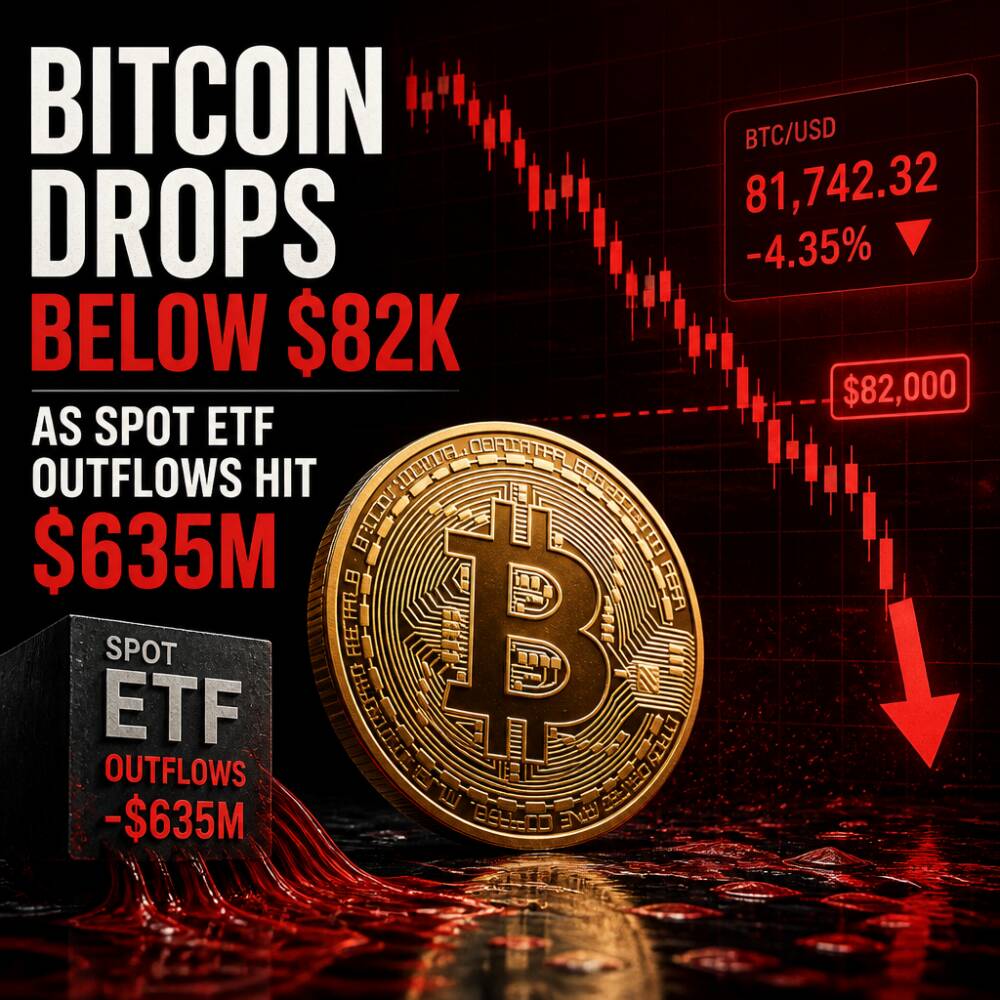
Bitcoin slipped below the 82,000 level in Asian trading on Friday, extending losses as selling spread from US equities into risk assets. The move coincided with $635 million in net outflows from US spot Bitcoin exchange-traded funds, signaling a pause in the institutional demand that had supported prices in recent sessions.
At the time of writing, Bitcoin was down 1.3% at $81,623. The decline followed a sharp sell-off in US stocks on Thursday, when technology and semiconductor shares led declines and weighed on overall risk appetite.
Key takeaways
- Bitcoin fell to around $81,623, after dipping below $82,000, extending weakness from Thursday’s broader risk-off move.
- Spot Bitcoin ETF flows turned negative: US-listed funds saw more than $635 million in net outflows, ending a three-day inflow streak.
- US market pressure drove sentiment: a tech-led decline in major indexes and sharp weakness in semiconductors reduced appetite for high-beta assets.
- Geopolitics boosted oil prices: rising crude prices tied to Middle East tensions increased inflation concerns.
- Next catalyst hinges on risk and flows: sustained ETF outflows could make it harder for Bitcoin to regain upside momentum if equities remain volatile.
What drove the move
Bitcoin’s weakness aligned with a shift in institutional flows. According to the article, US spot Bitcoin ETFs recorded over $635 million in net outflows on Thursday, interrupting a streak of positive flows that had run for three consecutive sessions.
The same report said US-listed spot Bitcoin ETFs attracted approximately $1.1 billion in net inflows so far this week, partially offsetting earlier selling pressure. The outflows therefore appear to have stalled a recovery rather than fully reversing the week’s overall demand.
Beyond crypto-specific flows, the pullback was also linked to broader market stress. Thursday’s sell-off in US equities—particularly technology and semiconductor names—fed into risk sentiment and spilled over into Bitcoin, which often trades as a rate- and risk-sensitive asset.
Market reaction across equities and what it implies
According to the report, US equity indexes moved lower on Thursday, with the Nasdaq Composite down 2.6% and the S&P 500 down 1.2%. The Philadelphia Semiconductor Index fell 6.7%, underlining how severe the risk repricing was in sectors tied to growth and capital spending cycles.
The article cited additional weakness in high-profile technology and platform names. Nvidia shares fell 4.4%, while Meta Platforms dropped 7% even after reporting stronger-than-expected revenue. The report also pointed to investor concerns about Meta’s rising AI spending and plans to issue new shares to support expansion.
It also noted sharp declines in other growth-linked equities, including SpaceX shares down 9% and Tesla down 3%, despite positive third-quarter earnings developments. Taken together, the reaction suggests investors are focusing less on near-term results and more on the financing and capital intensity required to sustain AI-related infrastructure build-outs.
Oil prices, geopolitics, and rate sensitivity
Geopolitical developments added another layer of uncertainty. The report said Brent crude climbed 3.7% to $112 a barrel as concerns about a potential escalation involving the United States and Iran raised fears about supply-chain disruptions.
Higher oil prices can feed into inflation expectations. That matters for Bitcoin because stronger inflation dynamics can complicate the path for monetary easing, leaving yields and borrowing costs less supportive for assets that benefit from easier financial conditions.
The article also highlighted that US midterm elections are less than two weeks away. With markets reassessing the potential implications for interest rates and financial conditions, the combination of election uncertainty and geopolitical risk can keep investors cautious across both equities and crypto.
What analysts are likely watching next
With Bitcoin’s recent rebound tied partly to ETF demand, the immediate focus for investors is whether ETF outflows persist. A continued negative flow trend could make it more difficult for prices to stabilize, particularly if equity volatility remains elevated.
The broader macro backdrop may also be a key driver. If oil prices stay firm or inflation concerns re-emerge, it could reinforce a higher-for-longer rate narrative—an environment that typically pressures risk assets. Conversely, any easing in geopolitical tensions or renewed inflows into spot Bitcoin ETFs could help Bitcoin regain momentum.
Going forward, investors will likely track the direction of spot ETF flows for confirmation that institutional demand is stabilizing. Attention will also remain on US market performance after the recent tech-led sell-off, and on inflation and oil-related developments ahead of major economic and policy signals, including forthcoming data and the US midterm election outcomes.


