

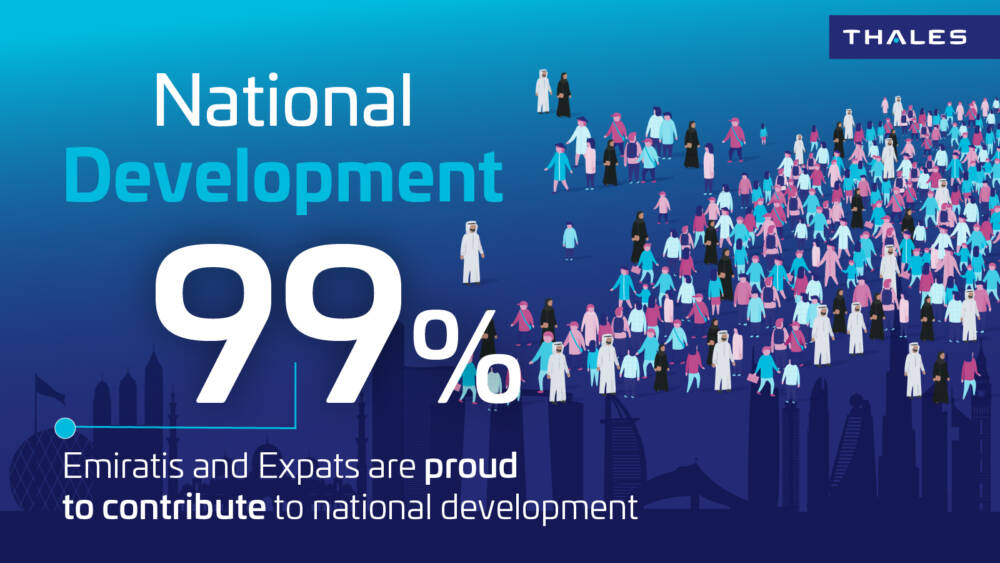
An independent survey commissioned by Thales suggests that nearly all respondents in the UAE, including both Emiratis and expatriates, associate their contribution with national development objectives.
The YouGov survey, conducted among more than 1,000 people across the UAE with 65% Emiratis and 35% UAE expatriates, found that 99% of respondents said they would feel proud knowing their contribution supports the country’s national development objectives. Thales said the results also show broad alignment between Emirati workforce expectations and the UAE’s industrial localisation agenda.
According to the survey results reported by Thales, more than 8 in 10 UAE nationals said they want to be part of technologies advancing the “Made in the Emirates” ecosystem. Nearly 90% of respondents emphasised the importance of products and technologies being developed locally, reflecting what the company described as rising expectations for capability building as the UAE moves toward a knowledge and innovation-driven economy under “We the UAE 2031”.
Local talent, technology and long term competitiveness
Thales said 92% of Emirati respondents and 87% of UAE expats agreed that sustained investment in local talent and advanced technologies is essential for the country’s long-term economic competitiveness. The company added that the survey also indicated growing expectations for corporate participation in national resilience and sovereignty.
More than three quarters of respondents, 77%, said it is important for companies to support national independence in areas including defence, digital security and critical infrastructure, Thales said.
When asked where companies should focus to support the UAE’s industrial ambitions, Emirati respondents and UAE expats prioritised developing a skilled local talent pool. Thales reported that Emiratis also highlighted building homegrown technology and innovation capacity, while UAE expats stressed environmental sustainability and resource management.
The survey pointed to expectations around expertise localisation, with nearly 70% of Emirati respondents and 65% of UAE expats saying multinational companies operating in the UAE should develop advanced technical and engineering capabilities locally, particularly as emerging industries scale.
Training programmes and expectations for technology change
Thales said respondents linked Emirati talent development to practical exposure and hands-on development. Training programmes in industrial technologies and networking opportunities with industry experts were each cited by 43% of respondents as valuable enablers for professional growth.
In support of these priorities, Thales described an “Early Careers Programme”, a one-year graduate training initiative intended to equip young Emiratis with technical skills, leadership capabilities and applied industry exposure, aligned with the UAE’s future skills’ agenda.
Looking ahead, Thales said the survey found significant expectations for technological change affecting the UAE’s economy and labour market. Half of UAE residents surveyed expect artificial intelligence (AI) and quantum technologies to drive job creation and diversification over the next decade. Thales reported that AI was cited by 65% as the most transformative technology for daily life in the next five years, followed by cybersecurity at 49%.
Despite the anticipated pace of change, Thales said confidence in education and training pathways remains strong, with 73% of Emiratis saying they feel prepared for future workforce demands.
Thales response
Pascale Sourisse, CEO of Thales International, commented on the findings, saying it was “remarkable” that 99% of Emiratis connect their contributions to national development and reflecting what Thales described as demand for investment in local engineering capabilities, skills development and technology transfer.
Thales also referenced its local research and development and talent development activities, including a radar manufacturing facility developed in partnership with Tawazun Council for Defence Enablement. Thales said the facility is expected to produce advanced Ground Master series air-surveillance radars in the UAE and become fully operational by 2027, supporting what it described as sovereign manufacturing capability and specialised Emirati expertise.


