

Key takeaways
- Nasdaq outlined plans for an issuer-centric equity token design, aiming to align tokenized equities with established U.S. market rights and governance.
- The catalyst is regulatory and market-structure work, including a tokenization proposal submitted to the SEC in September 2025 and an announcement in March 2026.
- Token transfers would be designed to map to real equity transfers, preserving legal and regulatory equivalence through integration with the issuer’s share registry.
- Investors and issuers could see lower operational friction as tokenization supports automation of settlement and corporate actions.
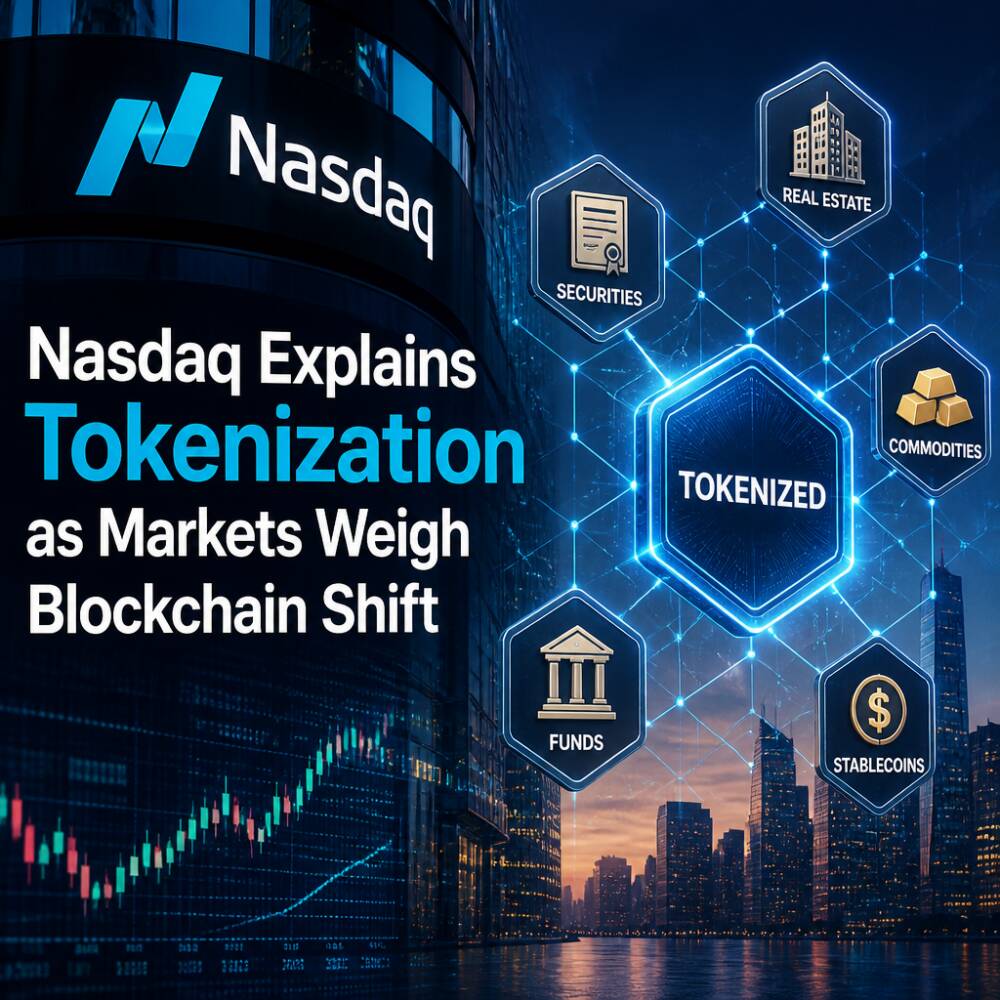
Nasdaq is pushing forward with an issuer-centric approach to tokenizing equities, positioning tokenization as a way to modernize securities infrastructure while preserving the legal framework of regulated markets. The company says its planned equity token design would link blockchain records directly to an issuer’s official share registry, with token transfers intended to represent transfers of the underlying security.
The move comes as capital markets increasingly explore always-on trading models and faster settlement, while technology-enabled cross-border flows test the limits of legacy operating systems. Nasdaq’s plan is intended to bridge on-chain activity with established U.S. equity market protections, governance, and price discovery.
What Nasdaq means by tokenization
Tokenization generally refers to representing a security on a blockchain using a digital token. Unlike the conventional book-entry systems used after paper certificates were replaced, the token creates a blockchain-based representation of ownership or economic exposure, depending on the design.
The article describes three main models:
- Custodial model: a third party holds the actual security, and issues a token that represents ownership of that underlying asset on the blockchain.
- Synthetic model: a token is linked to the performance of a security through a separate financial instrument, giving exposure without direct ownership of the underlying asset.
- Issuer-centric equity token design: a token designed to be fungible and interchangeable with the underlying equity, with the intent to integrate into existing institutional workflows and enable more programmable, automated market operations over time.
Nasdaq’s planned equity token design and its regulatory intent
According to Nasdaq, it announced in March 2026 that it would work toward launching an equity token design that centers public companies in ownership rights, investor experience, transparency, and governance. Nasdaq previously filed a tokenization proposal with the U.S. Securities and Exchange Commission in September 2025, proposing that equity securities could be enabled to trade on its markets and settle in token form.
The design described by Nasdaq is intended to preserve legal and regulatory equivalence. Nasdaq says the transfer of a token would constitute a transfer of the underlying security itself. It also says blockchain records would be integrated directly into the issuer’s official share registry, creating a regulated bridge between on-chain records and off-chain identity.
Nasdaq frames the approach around giving issuers meaningful control over how their securities exist in tokenized form. It also emphasizes standardization and interoperability, aiming to avoid bespoke, one-off implementations that can increase complexity and fragmentation across the ecosystem.
“We want to give the issuers, number one, the choice: Do they want their securities to be tokenized? Secondly, control in terms of understanding who their investors are, modernizing their experience and connecting with those investors,” Nasdaq Chair and CEO Adena Friedman said, according to the company’s materials referenced in the article.
Why tokenization matters for market operations
Nasdaq argues that tokenization’s value extends beyond faster settlement and process improvements, especially as market structure moves toward extended and potentially continuous trading. Supporting around-the-clock markets, the company says, requires infrastructure that can move ownership records, collateral, and liquidity efficiently across longer windows.
In its description of benefits, Nasdaq highlights how embedding standardized data and automation into digital securities could streamline settlement and securities processing workflows. The article notes potential use cases including automation of corporate actions and reduction in operational friction through more direct, auditable connections between issuers and investors.
Nasdaq Executive Vice President and Global Chief Legal, Risk and Regulatory Officer John Zecca is cited in the article describing the operational burden created by manual handoffs and data reconciliations across issuers, intermediaries, and market infrastructure providers. According to the company, corporate actions processing carries a structural cost of more than $58 billion across the industry, driven largely by fragmented systems, manual workflows, and duplicative recordkeeping.
While the company does not tie its estimates to a specific tokenization timeline, the implication for investors is clear: tokenization could reduce delays and operational risk in events like proxy voting and other corporate actions, potentially improving transparency around governance-related processes.
Nasdaq’s broader strategy across on-chain and mainstream finance
Nasdaq positions itself as both an operator of market infrastructure and a technology provider across global financial systems. The article says Nasdaq connects pools of capital with the innovation economy through a footprint spanning 135+ markets and regulators, emphasizing trust and resilience as prerequisites for institutional adoption.
According to the article, Nasdaq is pursuing initiatives designed to converge on-chain and off-chain ecosystems while preserving the liquidity, transparency, and integrity of regulated markets. It references the company’s Nasdaq Eqlipse Digital platform, described as designed to help market operators connect mainstream and tokenized markets.
The company also points to partnerships—including with the Canton Network, Talos, and Baton Systems—intended to integrate on-chain capabilities with existing institutional workflows. Nasdaq says this approach is aimed at improving capital efficiency and accelerating collateral mobility across the global financial system.
In addition, the article cites Nasdaq’s index business and regulated investment products as part of a broader framework for bringing digital assets into traditional finance. It mentions benchmarks such as the Nasdaq CME Crypto Index (CMI) for investable products tracking cryptocurrency performance, along with spot-bitcoin and Ethereum ETFs listed on Nasdaq markets.
From an equity-token standpoint, Nasdaq argues that as tokenized equities—and certain synthetic equity contracts—circulate across more platforms, an issuer-centric model becomes increasingly important. The company’s stated reason is to ensure blockchain records integrate with the issuer’s official share registry, so that a token transfer corresponds to a transfer of the underlying security, preserving legal and regulatory equivalence.
Bigger picture for investors
Nasdaq’s push is designed to address a core tension in digital-asset market development: moving from experimental token systems to architectures that can support governance, compliance, and investor protections expected in regulated equities. By anchoring token transfers to issuer-maintained share registries, Nasdaq is attempting to make tokenized equities more compatible with mainstream market principles.
Investors watching this space may focus on how Nasdaq’s planned equity token design evolves from proposal to implementation, including regulatory progress following its September 2025 SEC filing and any subsequent updates around the March 2026 initiative. The next signals to monitor will be milestones on issuer participation, interoperability standards, and how tokenized settlement would operate alongside existing market infrastructure.


