

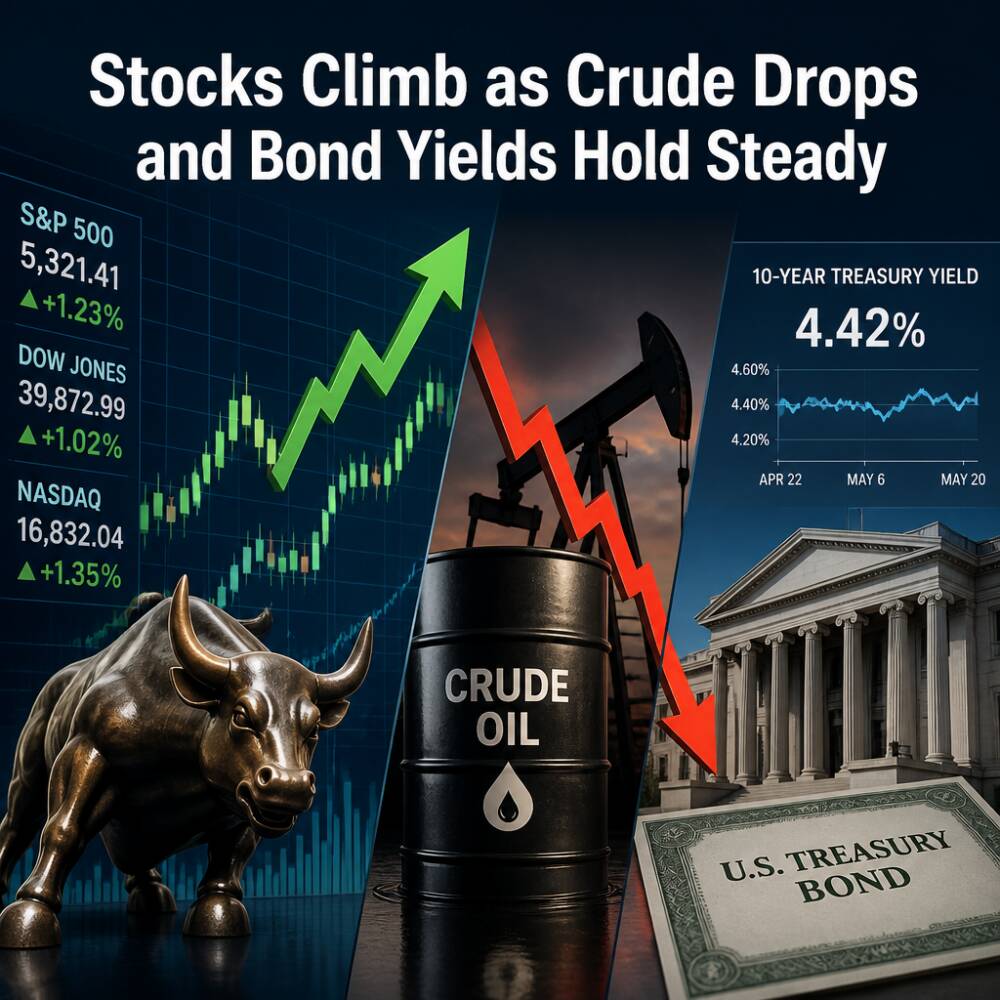
U.S. stock indexes rose modestly on the day as crude oil prices fell and Treasury yields held steady, supporting risk sentiment. The S&P 500 gained 0.26%, the Dow Jones Industrial Average added 0.45%, and the Nasdaq 100 was up 0.34%, with December equity index futures and Nasdaq futures also pointing higher.
The shift was linked to a decline in West Texas Intermediate crude following news that U.S. and Iranian negotiators are exploring a phased arrangement to reopen the Strait of Hormuz. Lower oil prices helped ease near-term inflation concerns, even as bond markets continued to react to hawkish guidance from Federal Reserve leadership and signs of firm U.S. capital spending.
Key takeaways
- Price move: The S&P 500 rose 0.26%, while the Dow gained 0.45% and the Nasdaq 100 added 0.34%.
- Catalyst: Weakness in WTI crude oil followed reports of progress toward a phased deal on Hormuz; U.S. Treasuries were also supported by stabilizing yield levels.
- Rates implication: The 10-year Treasury yield held near 5.18%, with trading influenced by hawkish remarks from New York Fed President John Williams.
- Sector rotation: Chip and artificial intelligence-linked stocks led gains, while cybersecurity and energy names lagged.
What drove the move
Energy and rates were key to the day’s tape. According to the market reporting, WTI crude prices were down more than 1% as U.S. and Iranian negotiators explored a phased deal to reopen the Strait of Hormuz. The Financial Times reported that Iranian Foreign Minister Abbas Araghchi submitted a new seven-day proposal to the U.S. tied to conditions for reopening Hormuz, a development that traders appeared to interpret as reducing near-term geopolitical and oil-supply risk.
At the same time, Treasury yields were described as stable after a strong prior move. The 10-year T-note yield had reached a 19-year high of 5.22% on Thursday, but was little changed around 5.18% during the session. Data and commentary pointed to a balance between easing inflation expectations from cheaper oil and hawkish Fed messaging.
In the background, New York Fed President John Williams said the Fed cannot ignore supply shocks if they persist in pushing prices higher and emphasized the need to return inflation to target. Traders also weighed fresh U.S. economic data that was stronger than expected: according to the report, August nondefense ex-aircraft capital goods new orders rose 1.6% month over month, above expectations of 0.6%, and July was revised to 0.6% from a previously reported flat reading. The data is commonly viewed as a proxy for business capital spending.
Market reaction in stocks and sectors
Equities climbed with support from technology exposure, particularly semiconductors and AI-related names. The iShares Semiconductor ETF was up more than 1%, while ARM Holdings shares rose more than 4% and several memory and analog chipmakers—including Micron Technology and Analog Devices—were higher by more than 2%.
Broader AI optimism also appeared to feed into large-cap tech. Akamai Technologies surged after agreeing to a seven-year $11.6 billion deal to provide computing power to Anthropic. Synopsys gained after HSBC upgraded the stock to buy from hold. Several other technology and infrastructure-linked names were also bid.
Cybersecurity stocks, however, were a drag. Zscaler fell more than 4% following the announcement of Ross Tackett as chief revenue officer effective October 1, while Palo Alto Networks dropped more than 3%. Okta and SentinelOne declined by more than 2% as a group.
Energy and services were weaker alongside the crude slide. Valero Energy fell more than 3%, and other large producers and refiners such as Devon Energy, Phillips 66, Marathon Petroleum, and Occidental Petroleum were down more than 1% to 2%.
Rates and macro signals investors are watching
Bond trading reflected the interplay between oil-driven inflation expectations and Fed policy risk. December 10-year T-notes fell by 2 ticks on the day, and the 10-year yield was described up about 0.4 basis points to 5.181%. The report indicated that T-notes reversed an overnight advance and edged lower after hawkish comments from John Williams, while earlier gains were linked to crude’s decline and some mid-session short covering.
European sovereign yields were mixed. The German 10-year bund yield rose modestly, while the UK 10-year gilt yield declined. Separately, the German GfK consumer confidence index fell 3.8 points to a five-month low of -30.6, weaker than expectations of -27.2. In European policy pricing, markets were discounting a 47% chance of a 25-basis-point rate hike by the ECB at its next meeting on October 29.
In the U.S., expectations for the next Federal Reserve meeting were described as pricing a 64% chance of a 25-basis-point hike on October 27–28. That framing matters for equities because it ties the outlook for discount rates to the path of inflation and supply-shock risk.
Notable company moves
- Atlas Energy Solutions rose more than 15% after announcing a purchase agreement with Wyoming Machinery Company for $340.5 million of balance of plant equipment for a power generation project.
- People Inc. climbed more than 9% after the Wall Street Journal reported that MGM Resorts International is discussing making a bid for the company.
- Synopsys gained more than 3% after HSBC upgraded the stock to buy from hold.
- Twilio fell more than 3% after HSBC downgraded the stock to reduce from hold.
- Lionsgate Studios declined more than 2% after JPMorgan initiated coverage with an underweight stance.
- Comcast fell more than 2% after KeyBanc Capital Markets downgraded the stock to underweight from sector weight.
- Nike dropped more than 1% after Bank of America Global Research downgraded the stock to underperform from neutral.
Looking ahead, investors will likely focus on how oil-market developments tied to the Strait of Hormuz evolve, whether Treasury yields remain capped near current levels, and the next wave of U.S. data and central-bank guidance. With no earnings reports listed for 9/25/2026 in the source material, attention may shift to upcoming macro releases and the Fed’s next communication ahead of the October FOMC meeting.


