

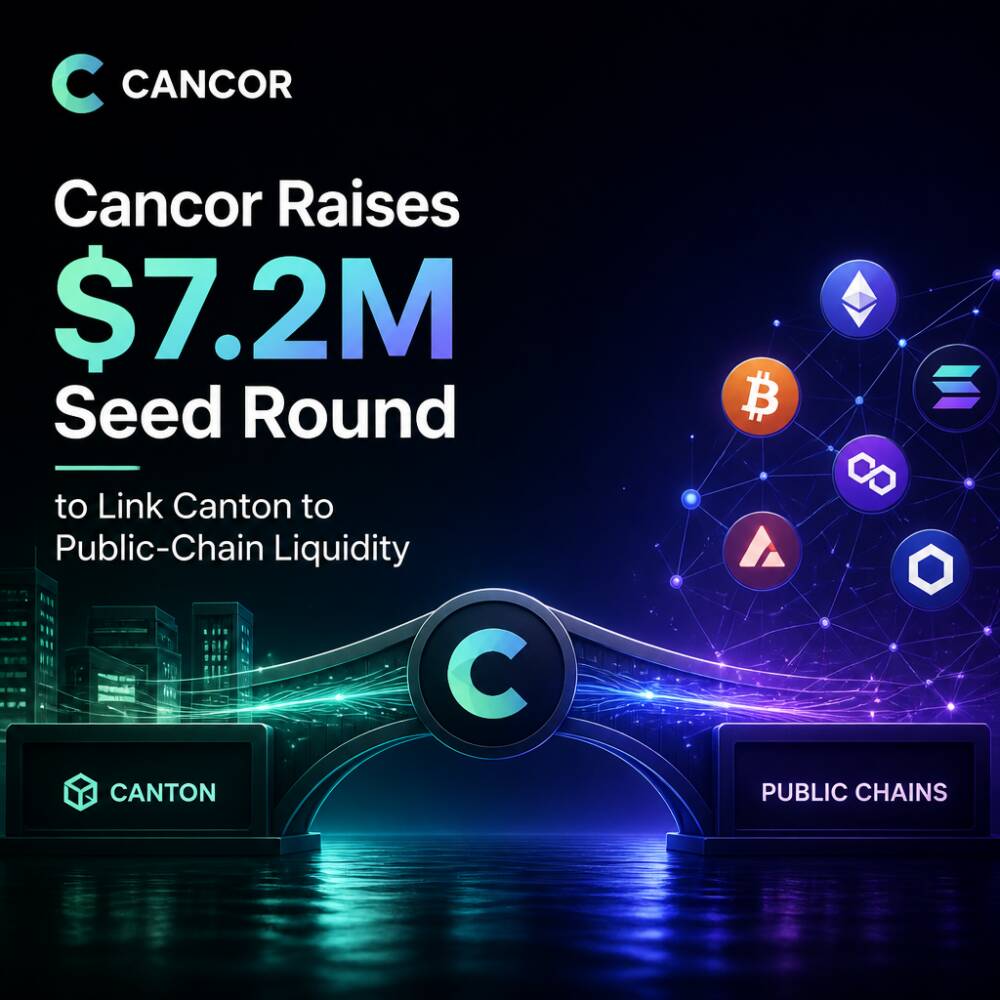
Cancore, a platform aimed at linking tokenized assets issued on Canton with liquidity on public blockchains, has raised $7.2 million in a seed funding round, the company said. The funding will be used to expand its network connectivity and continue building infrastructure for agentic trading, security, and settlement.
Cancore has been live on Canton mainnet since April 2026, where it currently operates as both a validator and a Featured App. As of October 1, the company reported cumulative trading volume of more than $53.2 million across over 84,000 trades, generating more than $538,000 in protocol revenue.
Key takeaways
- Cancore raised $7.2 million in seed funding, aimed at connecting Canton-native tokenized assets to public-chain liquidity.
- Funding focus: expansion of blockchain network connectivity and continued development of settlement and trading infrastructure.
- Live traction reported: more than $53.2 million in cumulative trading volume and over 84,000 trades as of October 1.
- Implication for tokenized markets: the company is targeting a missing “execution layer” between institutional-grade tokenization and public blockchain liquidity.
What Cancore said it is building
Cancore is developing infrastructure designed to connect assets native to Canton—such as tokenized real-world assets—with liquidity across multiple public blockchain networks. The company positions its product as a “Liquidity OS for Tokenized Finance,” focused on enabling asset execution and liquidity access across blockchain ecosystems.
To support cross-network transactions, Cancore uses atomic settlement, which it says is intended to ensure transactions complete fully or fail without partial execution. It also said users maintain control of their private keys via its self-custody wallet, while swaps are designed to settle across both networks or be refunded.
How it works with public chains and agentic trading
According to Cancore, the platform currently supports connectivity across Canton, Ethereum Virtual Machine (EVM)-compatible networks, and Tron. The company said the goal is to provide a single execution layer that allows trading agents to interact with Canton-native assets, tokenized RWAs, and liquidity from public chains.
Cancore also highlighted automation features through a Model Context Protocol (MCP) server. The company said this allows users to automate actions and delegate certain tasks to AI systems. The next planned step is to enable users to build and deploy their own trading agents to execute strategies, rebalance portfolios, allocate capital, and interact with liquidity.
Funding rationale and investor perspectives
Cancore’s seed round includes Paper Ventures, dao5, ArkStream Capital, X Ventures, MH Ventures, and Proof of Talk. In comments accompanying the announcement, ArkStream Capital partner Ye Su said Canton has established institutional foundations and the next step is opening it to broader market liquidity. Su also said Cancore’s approach is focused on live usage and revenue rather than “hype.”
Cancore co-founder and CEO Wasif Rashid said tokenization is expanding the range of financial assets on-chain, but programmable execution is the next milestone. He also pointed to a future in which users can deploy capital across tokenized assets and use agents to execute strategies and manage positions.
Paper Ventures general partner Danish Chaudhry said traditional markets derive value from the infrastructure that moves capital between venues, including clearing and settlement and prime brokerage. He argued tokenized markets will require a comparable layer, adding that between Canton and public chains such infrastructure “barely exists today.”
Bigger picture for tokenized finance
With institutional-grade tokenization expanding across permissioned ecosystems like Canton, the primary challenge for broader market adoption has been how to route execution and settlement to public-chain liquidity efficiently and securely. Cancore’s reported focus on atomic settlement, self-custody controls, and cross-network execution is designed to address that gap.
By tying agentic automation to settlement infrastructure—while also funding additional network connectivity—the company is attempting to position itself as a bridge between token issuance on Canton and trading activity across major public blockchain environments.
Investors will likely watch whether Cancore can scale its connectivity, deepen liquidity access across networks, and expand its agentic trading capabilities without compromising security. Upcoming milestones include further rollout of blockchain integrations and continued development of its settlement and security infrastructure as it applies the new seed funding.


