

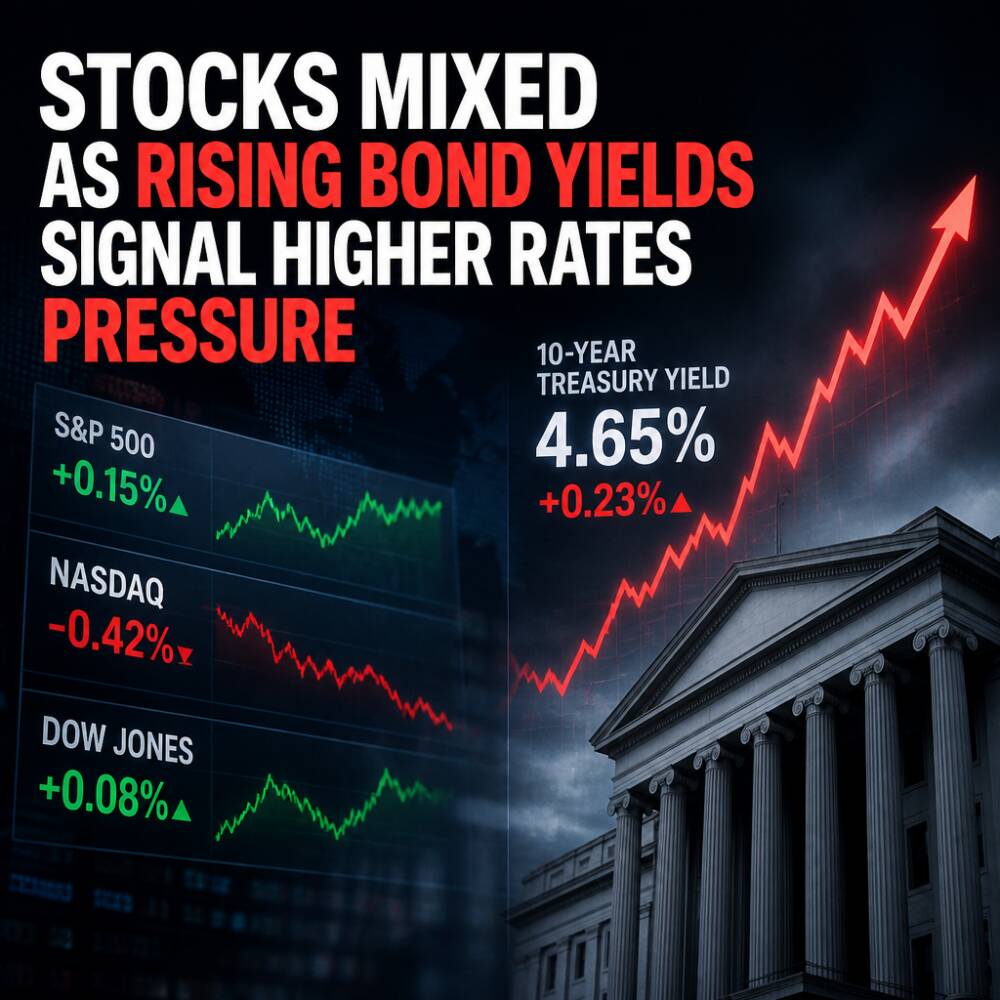
U.S. stock indexes traded mixed on the day, with the Nasdaq 100 extending to a 2-1/2 month high while the S&P 500 and Dow Jones fell slightly. Chip-related strength helped underpin the broader market, but gains faded as Treasury yields rose to a one-month high on hawkish comments from Federal Reserve Vice Chair Jefferson and concern that tariff policy could complicate disinflation.
In corporate news, several stocks moved on quarterly results and guidance updates, while gold miners slid as COMEX gold slipped to a one-month low. Bond markets also reflected shifting inflation expectations, with the U.S. 10-year breakeven inflation rate climbing to a six-week high.
Key takeaways
- Indexes mixed: The S&P 500 and Dow Jones were slightly lower, while the Nasdaq 100 rose, reaching a 2-1/2 month high.
- Catalyst: Strength in chip stocks supported the tech-heavy benchmark, while rising Treasury yields and hawkish Fed messaging weighed on risk sentiment.
- Implication: Investors appear to be balancing an AI/semiconductor optimism backdrop against renewed rate sensitivity tied to inflation and tariff risks.
- Rates signal watch: The 10-year yield moved higher toward a one-month peak, pressuring fixed income and influencing equity valuation multiples.
What drove the move
Technology and semiconductor stocks were a key source of support for the market. Chipmakers helped lift major indexes even as broader momentum softened from earlier highs.
According to the report, the Trump administration is expected to sign agreements expanding Saudi Arabia and the United Arab Emirates’ access to advanced AI chips, with companies including Nvidia, Advanced Micro Devices, and Amazon.com investing in related projects such as data centers and AI infrastructure. The Commerce Department also said it is rescinding an AI diffusion rule launched under President Biden, while the administration plans to overhaul semiconductor export regulations, potentially shifting toward country-by-country arrangements.
Offsetting that optimism, stocks pulled back as U.S. Treasury yields rose. According to the report, Fed Vice Chair Jefferson said he has lowered his 2025 growth forecast but believes expansion will continue, and warned that tariff increases—if sustained—could interrupt progress on disinflation and contribute to at least temporary inflation pressure. That messaging contributed to the upward move in yields and weighed on equity sentiment.
Market reaction: rates, commodities and sectors
Bond markets were a major swing factor. The report said June 10-year Treasury futures dropped to a one-month low and the 10-year yield climbed to a one-month high. It also cited rising inflation expectations as bearish for Treasuries, noting that the U.S. 10-year breakeven inflation rate reached a six-week high.
Europe’s rates also moved higher, with the report pointing to increases in German bund and UK gilt yields to one-month highs.
On commodities, gold and gold-related equities moved in opposite directions. The report said COMEX gold declined to a one-month low, and gold mining stocks slid broadly, including AngloGold Ashanti, Newmont, and Gold Fields.
In corporate sectors, healthcare and select technology names showed notable relative strength, while other groups underperformed on guidance changes, analyst downgrades, or financing-related developments.
Stock-specific movers and earnings updates
Several individual stocks gained on company-specific news. The report said Advanced Micro Devices rose more than 5% and ARM Holdings rose more than 4%, reinforcing the technology-led bid. Nvidia also advanced modestly, supporting gains in the Dow.
In healthcare, the report said previously pressured health insurance stocks rebounded, with UnitedHealth Group up more than 3% and Molina Healthcare up more than 2%, alongside increases in Cigna, Elevance Health, and Humana.
Other notable gainers included Super Micro Computer, which jumped more than 16% after the report linked the move to a partnership agreement involving its data center business. The report also said Exelixis rose more than 19% after reporting Q1 revenue that beat consensus and raising its full-year revenue guidance. Dynatrace gained more than 5% on Q4 results and a stronger-than-expected 2026 revenue outlook.
Not all moves were positive. The report said gold miners fell alongside gold prices, and several stocks declined after corporate or analyst-driven news. Loar Holdings fell more than 7% after shareholders planned to sell nine million shares via a one-day marketed offering. American Eagle Outfitters dropped more than 5% after withdrawing fiscal year 2025 guidance due to macroeconomic uncertainty. Other decliners cited in the report included Cboe Global Markets, Target, and Consolidated Edison, each weighed down by analyst actions or price-target changes.
Bigger picture: what investors are watching
Investor focus this week is on tariff-related developments and the outlook for additional trade deals, alongside a dense slate of U.S. economic data. According to the report, markets are watching scheduled releases including retail sales, producer price inflation, manufacturing production, housing starts and building permits, and a preliminary University of Michigan consumer sentiment reading.
Rates expectations also remain central. The report said markets are pricing an 8% chance of a 25 basis point rate cut after the June 17-18 FOMC meeting.
Meanwhile, earnings momentum continues to cool but remains supportive. According to the report, more than 80% of S&P 500 companies have reported so far, with 77% beating estimates. It also said Q1 earnings growth is running at 13.1%, compared with a 6.6% expectation heading into the season, while full-year 2025 corporate profit expectations were revised to 9.4% from an earlier 12.5% forecast.
Overseas trading was mixed, with the report citing a decline in the Euro Stoxx 50 and Japan’s Nikkei, while China’s Shanghai Composite rose to a multi-week high.
What to watch next: The next catalysts are tariff and trade-deal headlines, followed by U.S. data on retail sales, inflation (PPI), manufacturing output, housing activity, and consumer sentiment. With the 10-year yield at elevated levels and Fed commentary still influencing rate expectations, investors will likely monitor both economic prints and any shifts in guidance from companies reporting over the coming days.


