

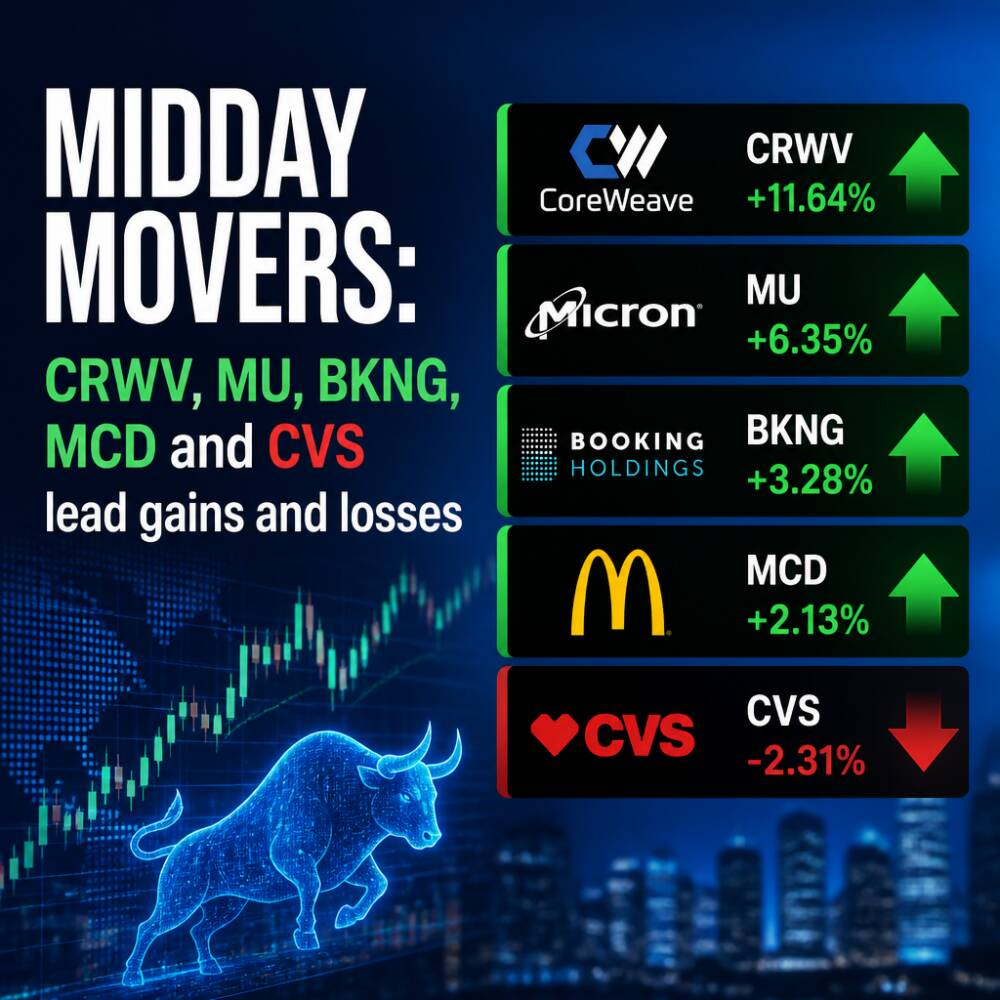
U.S. stocks saw sharp midday moves across sectors, as investors digested election-driven policy expectations and a wave of earnings and guidance updates. Shares tied to AI data centers and defense were among the biggest decliners, while identity verification, some software names, select retailers, and several healthcare companies advanced after results or outlook changes.
Separately, company-specific guidance revisions drove outsized swings in individual stocks, including a steep drop at Trimble and FIS after earnings outlook cuts, contrasted with strong gains for AppLovin, Clear Secure and Duolingo on either better forecasts or results.
Key takeaways
- Price move: AI infrastructure and defense-related shares led decliners, while booking-focused retail and several software and healthcare names climbed.
- Catalyst: Investors repriced expectations after Democrats’ midterm wins and digested earnings and forecast updates across multiple industries.
- Key implication: Policy uncertainty around data center build-outs is weighing on AI infrastructure plays, even as company results continue to drive stock-specific re-ratings.
- Watch item: Full-year guidance revisions and fourth-quarter revenue outlooks are likely to remain the biggest drivers into upcoming reporting.
AI infrastructure and defense take the biggest hits
Companies associated with AI infrastructure and data center expansion fell after Democrats’ midterm election victories, with traders preparing for what they saw as potential headwinds to the pace of build-outs. The iShares A.I. Innovation and Tech Active ETF slid more than 2%, while Comfort Systems dropped 17% and Vistra fell 13%.
Memory-related stocks also declined, with Micron down about 5% and Sandisk down roughly 7%. The weakness reflected investor sensitivity to policy signals that could affect permitting, local approvals, and overall momentum for data center investment.
Defense stocks moved lower in a similar market-wide reaction. The iShares U.S. Aerospace & Defense ETF fell more than 1%, and Lockheed Martin dropped 6%. Howmet Aerospace and Northrop Grumman each fell more than 4%, indicating investors were broadly repricing the sector around potential changes to legislative priorities following Democrats’ control of Congress.
Election-driven pressure hits Trump Media and data center expectations
Trump Media & Technology Group shares fell 11% after Democrats secured decisive control in U.S. midterm elections. The company’s ownership structure remains a key market focus, with President Donald Trump holding 41% of the business behind the Truth Social platform.
Investors also appeared to tie the broader policy read-through to large-scale infrastructure spending. Tesla and SpaceX shares each declined about 3% after the Democrats won control of both the House and the Senate, while several newly elected candidates have criticized the rapid data center build-out fueled by artificial intelligence. SpaceX runs an AI supercomputing infrastructure in Tennessee and Mississippi, while Tesla operates an AI infrastructure in Texas.
So-called “neocloud” stocks also fell, including CoreWeave down 9%, Iren down 11% and Nebius down about 6%. Market pricing suggests investors expect increased friction for data center plays, especially in jurisdictions where voters have shown resistance to new facilities.
Company guidance shocks reshape individual stocks
Not all declines were policy-driven; several were tied directly to earnings outlook changes. Trimble shares fell nearly 18% after the company reduced its expected organic annual recurring revenue growth for 2026 to roughly 10%, down from its prior range of 12% to 14%.
Fidelity National Information Services (FIS) dropped 24% after cutting its full-year earnings outlook. The company forecast adjusted earnings per share of $5.82 to $5.89, below its prior expectation of $6.15 to $6.24, underscoring investor focus on margin and expense discipline assumptions going forward.
Datadog fell 14% even though it beat on top and bottom lines. The cloud monitoring company’s revenue guidance for the fourth quarter came in soft, with expectations for revenue of $1.19 billion to $1.20 billion versus the $1.20 billion consensus estimate, illustrating how forward guidance can outweigh current quarter outperformance.
Earnings beats and raised forecasts lift software, identity and fintech
While multiple names slid, several stocks surged on results or improved forward guidance. AppLovin jumped more than 10% as investors positioned for its third-quarter results after the bell. Analysts polled by FactSet expected earnings per share of $4.03 on revenue of $2.075 billion.
Clear Secure surged 33% after lifting its full-year forecast for free cash flow. The company now expects at least $490 million in free cash flow, above the FactSet consensus of $482.9 million, and it also reported third-quarter results that beat estimates.
Duolingo rallied 32% after reporting third-quarter revenue of $309 million, topping an LSEG consensus estimate of $303 million. The company reported monthly active users of 153 million versus a forecast of 149 million, and its adjusted EBITDA margin also exceeded expectations.
Block rose nearly 16% after reporting third-quarter earnings and revenue above expectations and raising full-year guidance for the year ending in December. Adjusted earnings were $1.13 per share versus a $1.03 LSEG consensus, while revenue of $6.72 billion beat the $6.59 billion estimate.
Consumer, healthcare and energy-linked names diverge
In consumer-focused trading, cyclical retailers gained momentum after Booking Holdings delivered better-than-expected results. Booking jumped 11% and Expedia rose 13%. Nike gained more than 6% and Amazon climbed nearly 7%, signaling broad interest in consumer spending indicators alongside company-specific updates.
Healthcare stocks also showed strength. Novo Nordisk advanced more than 6% after reporting earnings of 5.79 Danish kroner (about 63 cents) versus the Street’s expectation of 5.10 kroner (about 55 cents). The company also raised its fiscal 2026 outlook, citing expectations for GLP-1 product sales.
McDonald’s shares rose about 5% after mixed quarterly results. Adjusted earnings were $3.57 per share, above the $3.38 expected by analysts polled by LSEG, although revenue of $7.16 billion missed the $7.29 billion consensus estimate.
CVS Health fell more than 12% after announcing plans to split into two separate publicly traded companies by the first half of 2028. The proposal would reverse CVS’s $78 billion acquisition of Aetna by separating its retail pharmacy business. Kraft Heinz gained 6% after announcing it will divest its North America coffee business to One Rock Capital Partners.
In renewable energy, shares rose following Democrats’ sweep of Congress. Sunrun and Plug Power each climbed about 7%, while Nextpower jumped 15%, reflecting how investors are reading policy outcomes differently across power generation and infrastructure segments.
Renewable power and data center-related trades moved in opposite directions, reinforcing that investors are not treating the entire AI and infrastructure theme uniformly; instead, they are parsing which business models benefit from policy and which face potential regulatory or permitting challenges.
What to watch next
Traders will likely focus on whether earnings guidance continues to diverge company-by-company, particularly around fourth-quarter revenue outlooks and full-year EPS forecasts. With the policy backdrop still central to pricing, investors may also watch for additional commentary on data center siting and regulatory priorities, alongside upcoming company reports and macro data that could influence rate expectations.


