

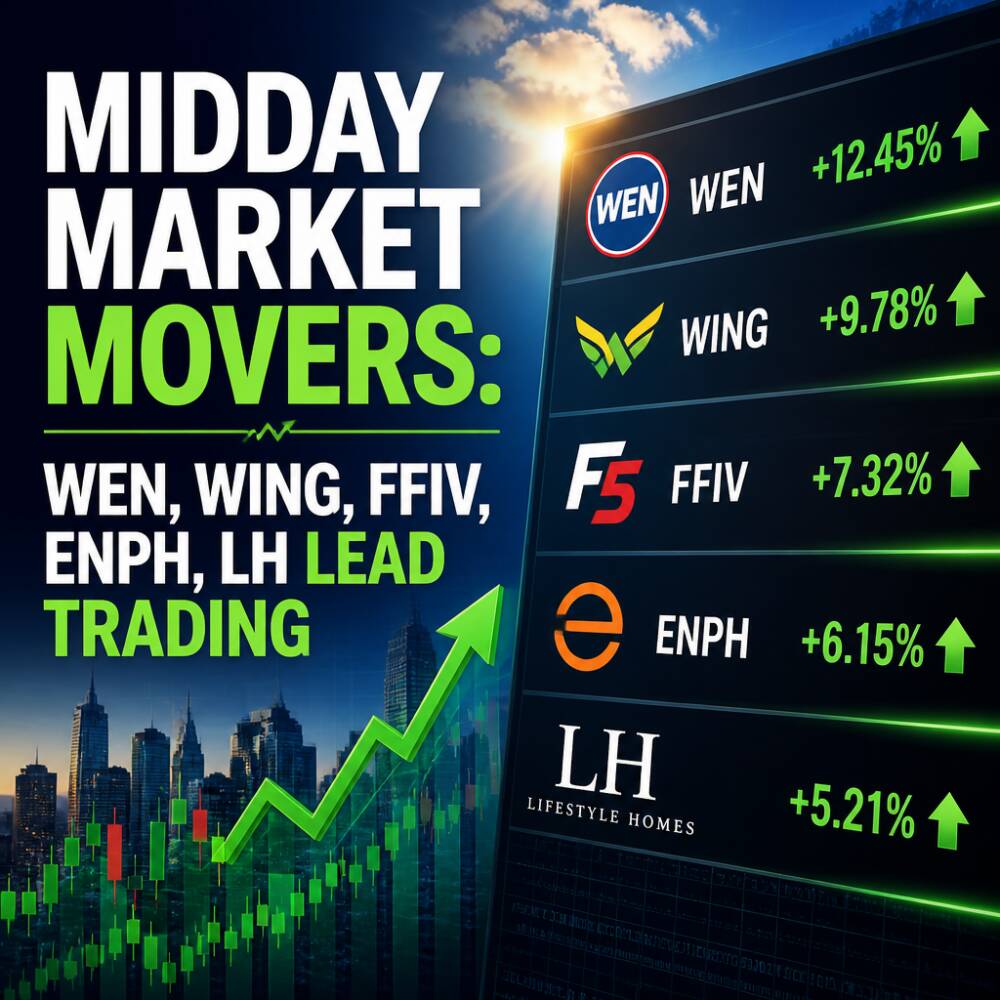
Midday trading saw sharp, company-specific swings across consumer, healthcare, technology and industrials, as investors digested takeover proposals, earnings results and updated guidance. Several stocks rallied on stronger-than-expected quarterly performance or raised outlooks, while others fell after revenue misses and cautious guidance.
Key takeaways
- Wendy’s shares rose after Trian Fund Management proposed taking the burger chain private for $1.4 billion, despite a prolonged streak of same-store sales declines.
- Brinker International gained on a full-year guidance raise, signaling resilience in operating expectations for the Chili’s owner.
- Wingstop jumped after earnings beat estimates, even as revenue fell short.
- F5 and Enphase Energy fell on guidance concerns and declining quarterly revenue, respectively.
- Ultralife surged following EnerSys’ agreement to buy the battery manufacturer for $16 per share in cash.
Deals and major corporate actions
Wendy’s climbed 15% after a regulatory filing showed Trian Fund Management proposed taking the company private for $1.4 billion. The move comes as Wendy’s has posted same-store sales declines for six consecutive quarters, making the offer a potential catalyst for investors focused on turnaround prospects and cost discipline.
Ultralife surged 145% after EnerSys agreed to acquire the battery maker for $16 per share in cash. The deal values Ultralife at about $320 million, and the merger agreement was announced after the market closed on Tuesday. EnerSys shares rose 2%, reflecting investor assessment of the acquisition’s strategic and financial impact.
GE Vernova shares fell 2% after the company agreed to acquire high-voltage components manufacturer Trench Group for approximately $9 billion. In a separate update, GE Vernova also lifted its full-year revenue forecast to a range of $46.5 billion to $47.5 billion, a detail that investors may weigh against the acquisition-related complexity and integration timeline.
Earnings and guidance moves
Brinker International rose 15% after raising full-year guidance for adjusted earnings of $13.30 to $13.90 per share, beating a FactSet consensus of $13.28. The company also increased its revenue projections, suggesting a constructive outlook for demand and cost performance.
Wingstop climbed 15% after third-quarter earnings topped estimates. The company reported $1.08 per share excluding certain items versus an LSEG-compiled consensus of $1.02 per share. However, revenue came in at $185 million, below the $193 million consensus, implying the stock reaction was driven primarily by profitability rather than top-line growth.
Labcorp advanced 10% following a guidance raise. The company expects adjusted earnings of $18.30 to $18.70 per share on revenue of $14.779 billion to $14.887 billion, while FactSet analysts were looking for $18.35 per share on $14.75 billion revenue. The update suggests investors are rewarding improving visibility in diagnostic demand and operating execution.
GE HealthCare Technologies gained 8% after it raised its full-year outlook. The company projected adjusted earnings of $4.95 to $5.05 per share and expected organic revenue growth of roughly 4% year over year, a combination that typically supports valuation for healthcare equipment and services investors.
Vertiv rallied 14% after results beat expectations and guidance strengthened. Vertiv reported adjusted earnings of $2.21 per share versus a FactSet estimate of $1.82, and revenue of $4.31 billion compared with a $3.75 billion consensus. The stock reaction indicates investors favored both near-term performance and the guidance trajectory for critical digital infrastructure demand.
Stocks that declined after results or outlooks
F5 dropped about 19% as investors reacted to guidance and analyst commentary. For fiscal year 2027, the company guided for non-GAAP earnings of $18 to $18.30 per share versus a FactSet consensus of $18.03. Piper Sandler also downgraded shares to neutral from overweight, adding to pressure as investors reassess risk/reward in cybersecurity.
CoStar fell 13% after full-year revenue guidance failed to impress. The company expects revenue of $3.75 billion to $3.77 billion, roughly in line with the FactSet consensus of $3.75 billion, implying investors were seeking stronger differentiation rather than guidance that largely matched expectations.
Enphase Energy slid 16% after quarterly revenue declined to $293.3 million from $410.4 million a year earlier. Fourth-quarter revenue guidance also missed the mark, ranging from $225 million to $255 million versus a FactSet consensus of $297.6 million. The magnitude of the revenue contraction drove the selloff, underscoring investors’ focus on demand stabilization in solar.
Robinhood dropped 2% after quarterly profit missed expectations. Earnings landed at 51 cents per share versus an LSEG consensus of 56 cents, with revenue rising 12% to $1.42 billion. Cryptocurrency revenue fell 55% to $120 million, a factor likely weighing on investor confidence in revenue mix and activity-related performance.
Logitech declined more than 11% after reporting mixed results for the fiscal second quarter. Although adjusted earnings per share of $1.51 beat a FactSet consensus of $1.30, operating income came in below expectations, indicating costs or profit conversion did not meet the Street’s targets.
SK hynix rose 11% after third-quarter operating profit beat the StreetAccount consensus, attributed to demand for artificial intelligence memory products. The company also announced a special dividend tied to gains from its Kioxia investment, reinforcing investor appetite for memory-related earnings momentum and capital returns.
PPG Industries gained nearly 6% after reporting quarterly earnings of $2.25 per share on an adjusted basis, exceeding a FactSet estimate of $2.12. PPG also raised the midpoint of its full-year earnings guidance, supporting the upward move.
Wingstop, Brinker International, Labcorp and GE HealthCare highlighted investors’ preference for companies that paired results with forward visibility, while F5 and Enphase Energy showed how quickly sentiment can shift when guidance or revenue trends diverge from expectations.
Bigger picture for investors
The midday tape reflected a common pattern in equity markets: investor sensitivity to guidance quality and profitability durability, particularly when revenue growth is uneven. For sectors spanning retail food, diagnostics and cybersecurity, the dominant driver was not only quarterly performance but the shape of forward expectations—while deal headlines added a separate layer of upside volatility.
Traders and long-term investors will likely focus next on whether raised guidance translates into sustained earnings momentum for recent winners, and whether companies falling on revenue or outlook misses can offer clearer stabilization signals in upcoming reports. Additional earnings updates and macro catalysts—including upcoming economic data releases and central bank commentary—could further influence risk appetite and rate expectations across sectors.


