

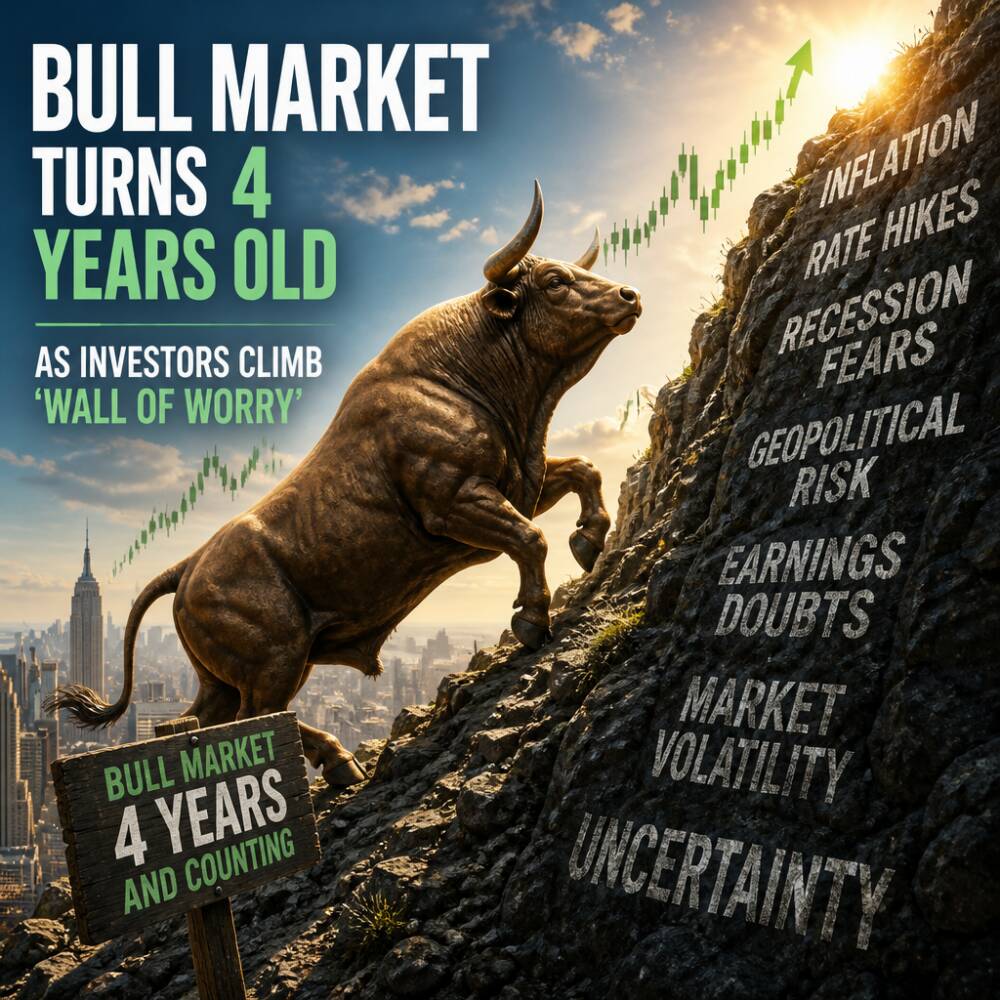
Wall Street marked the fourth anniversary of its current bull market on Monday, with the S&P 500 up nearly 120% from its closing low on Oct. 12, 2022. The long run has been closely tied to investor enthusiasm for artificial intelligence, particularly companies viewed as key beneficiaries of the AI build-out.
As the index reaches fresh highs, strategists and market participants are increasingly focused on whether rally momentum can persist amid concerns about higher inflation, rising bond yields and a more hawkish Federal Reserve. The debate centers on market breadth, the sustainability of big-tech leadership, and whether earnings can meet elevated expectations.
Key takeaways
- Price move: The S&P 500 has climbed nearly 120% since its Oct. 12, 2022 closing low.
- Catalyst: The rally has been fueled largely by demand for the AI trade that began after the release of ChatGPT in late 2022.
- Implication for investors: Deteriorating market breadth and signs of relative weakness in smaller stocks suggest the path ahead may be less smooth.
- What to watch: Upcoming earnings and the direction of interest-rate expectations may determine whether record levels can hold.
How the bull market was built
Since ChatGPT’s release in late 2022, investors have sought exposure to the technologies and suppliers associated with AI adoption. Shares of companies seen as “picks and shovels”—such as Nvidia and semiconductor equipment and memory suppliers—became central to the market’s advance.
Nvidia, previously known for graphics hardware tied to high-end video games, has grown into an AI bellwether. The company has been reported as reaching roughly a $5.5 trillion market capitalization and crossing the $1 trillion mark for the first time in 2023. Micron Technology has also been highlighted as a major beneficiary, having passed $1 trillion in market value for the first time this May.
The dominance of these themes has helped lift broader benchmarks even as macro conditions remained challenging at times. The S&P 500 has continued to hover near record levels, supported by the index’s heavy weighting toward technology—about 40% of the broader index, according to UBS, is in tech stocks.
Why investors are questioning what comes next
After four years of strong gains, investors are asking whether the rally can continue as rate-sensitive concerns resurface. The backdrop includes ongoing worries about inflation, surging bond yields and a Fed stance that market participants describe as more hawkish. Those factors matter because they influence discount rates and can shift leadership away from long-duration growth stocks.
Technically, the outlook is described as less favorable. According to Oppenheimer’s Ari Wald, the current bull market is the sixth longest among 24 market cycles dating back to 1932. Wald also pointed to data suggesting the median time remaining before a cycle peaks is about 13 months, implying that 2027 could be the “final leg” for this cycle.
At the same time, Wald noted that the median fifth-year return was still 21%, suggesting investors may still have room for further gains before any peak.
Market breadth, earnings and the risk of leadership narrowing
Beyond the timing question, the quality of the rally is under scrutiny. Data cited in the market coverage indicates that market breadth has deteriorated. In September, 75% of S&P 500 stocks reportedly closed in negative territory, as investors shifted toward a smaller group of mega-cap names amid the pull of higher interest-rate expectations.
Smaller companies have been a particular weak spot. Oppenheimer’s Wald said he is monitoring the Russell 2000’s test of its 200-day moving average to gauge whether the bull market still has room to run. He wrote that, in his view, relative weakness should be treated as a warning rather than a tradable setup until stronger conditions return.
Earnings expectations also present a challenge. While the third-quarter reporting season is expected to be strong, some investors worry that results may not be strong enough to sustain prices given how high expectations have risen over the past four years.
Technology leadership is another focal point. Deutsche Bank strategist Parag Thatte said the rotation into tech appears “overdone,” with the risk-reward no longer looking favorable. That stance reflects the possibility that the market’s AI-driven leadership could face diminishing incremental upside if expectations have already been widely priced in.
Bigger picture: balancing optimism with selectivity
Despite the uncertainties around rates, breadth and earnings, some investors remain confident that the U.S. stock market can extend higher. The resilience of equities over the past four years has been tied to strong fundamentals alongside the AI build-out, though multiple participants suggest stock selection may become harder as leadership concentrates further.
Adam Parker, founder of Trivariate Research, wrote that outperformance depends on holding companies that combine fast growth with the ability not to miss key targets—“a combination” that remains the firm’s core approach. Parker also added that he continues to think the U.S. stock market will perform well.
For traders and long-term investors alike, the next phase may hinge on whether earnings can validate today’s valuations and whether interest-rate expectations stabilize enough to keep risk appetite intact. With the bull market entering its fifth year, investors are likely to watch closely how breadth evolves, whether smaller-cap strength returns, and how the Federal Reserve frames its path for inflation and policy.


