

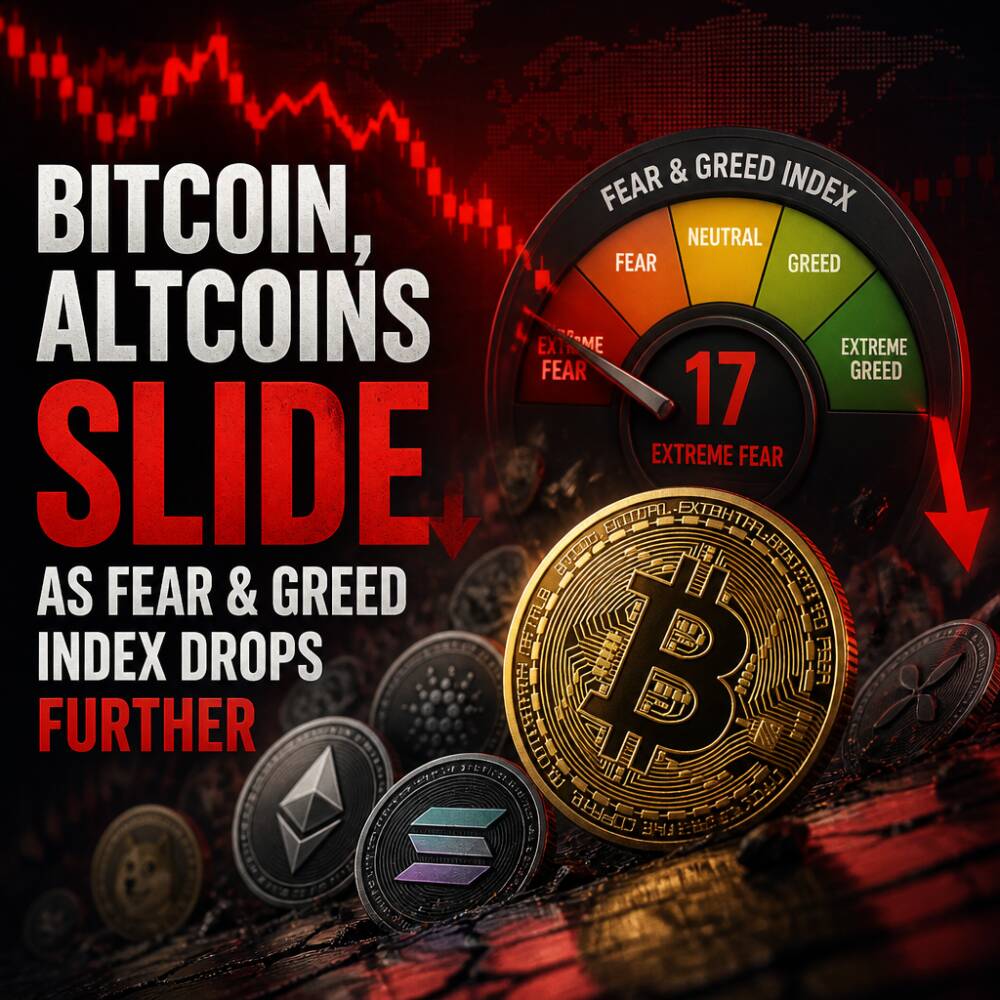
Bitcoin and most major altcoins extended their weekend slide, with prices hitting the lowest levels in months as broader crypto valuations continued to contract. Since September, the crypto market has shed more than $750 billion in value, pushing total token valuations to about $2.1 trillion, according to the report.
Investors pointed to a combination of worsening risk sentiment, rising US Treasury yields, and continued outflows from spot crypto exchange-traded products, alongside technical deterioration in Bitcoin that has historically reinforced selling pressure.
Key takeaways
- Price move: Bitcoin and most altcoins fell to multi-month lows over the weekend.
- Catalyst: The Crypto Fear and Greed Index slid into “extreme fear,” while US bond yields rose on expectations for further Federal Reserve tightening.
- Flows and positioning: Spot Bitcoin ETF outflows exceeded $1 billion this month, and leveraged crypto positions were liquidated, adding to downside momentum.
- Implication: With sentiment deeply negative and yields firm, the risk of additional volatility remains elevated.
What drove the move
A central factor cited in the sell-off is the level of investor fear. The report highlighted the Crypto Fear and Greed Index, which dropped to an “extreme fear” reading of 12 during the weekend—its lowest level in months. The index is designed to mirror sentiment gauges used in equities, drawing on crypto-specific inputs such as Bitcoin’s price action, derivatives activity, and social media signals.
When the index falls further, the report said it often coincides with panic selling. It also noted that crypto recoveries can begin when the index reaches extreme fear, while prolonged bear phases typically start as the metric shifts toward “greed.”
Rates pressure and macro expectations
Rising US bond yields added to the pressure, with the report attributing the move in part to shifting expectations for the Federal Reserve. It said the benchmark 10-year Treasury yield has jumped this month and crossed the 5% level, with the pace potentially accelerating.
The report tied yields to a sequence of economic releases. It referenced third-quarter economic growth of 3.4% and employment gains, saying data showed the economy added more than 165,000 jobs in the prior month, alongside a decline in the unemployment rate to 4.1%. It also cited the recent behavior of inflation, stating inflation has remained broadly steady over the past five years, a backdrop it linked to the effects of the US-Iran conflict.
Against that macro backdrop, market participants are weighing whether the Fed will raise rates by 0.25% or 0.50% in December, according to the report. For crypto, higher yields generally tighten financial conditions and can reduce demand for high-risk assets, reinforcing sell-offs.
ETF outflows, liquidations, and spillover from equities
The report also pointed to sustained outflows from spot crypto ETFs. It said spot Bitcoin ETFs have shed more than $1 billion in assets this month. It added that spot Ethereum and XRP ETFs have continued recording outflows, which it framed as a sign that both retail and institutional investors in the US expect prices to fall.
Positioning appears to be compounding the decline. The report said liquidations have removed more than $3 billion of value over the past week, a dynamic that can mechanically drive additional selling when leveraged bets are forced to close.
It also noted a broader risk-off tone across markets. The report said major equity indexes—including the Dow Jones, Nasdaq 100, and the S&P 500—were down more than 3% from their peak levels, and that even large technology names such as Nvidia and Micron have moved into deep bear-market territory. That correlation matters because crypto often trades as a high-beta component of global risk sentiment.
Bitcoin’s technicals add momentum to selling
Beyond macro and flows, the report cited technical signals that can magnify downside. It said Bitcoin formed a double-top pattern at $87,200, marking the start of its bear market. It added that Bitcoin is approaching a “death cross” setup, which occurs when the 50-day moving average falls below the 200-day exponential moving average.
The report also said Bitcoin has slipped below the 61.8% Fibonacci retracement level. In its interpretation, that raises the risk of further declines, potentially extending weakness across the broader crypto complex.
Bigger picture: what to watch next
With sentiment in extreme fear, yields still an active driver, and ETF outflows plus liquidations continuing to shape flows, investors will likely focus on whether the Fear and Greed Index stabilizes and whether US rate expectations begin to ease. Next catalysts include upcoming US economic data and Fed messaging, alongside continued reporting on spot ETF flows that can either reinforce the current downtrend or signal that selling pressure is fading.


