

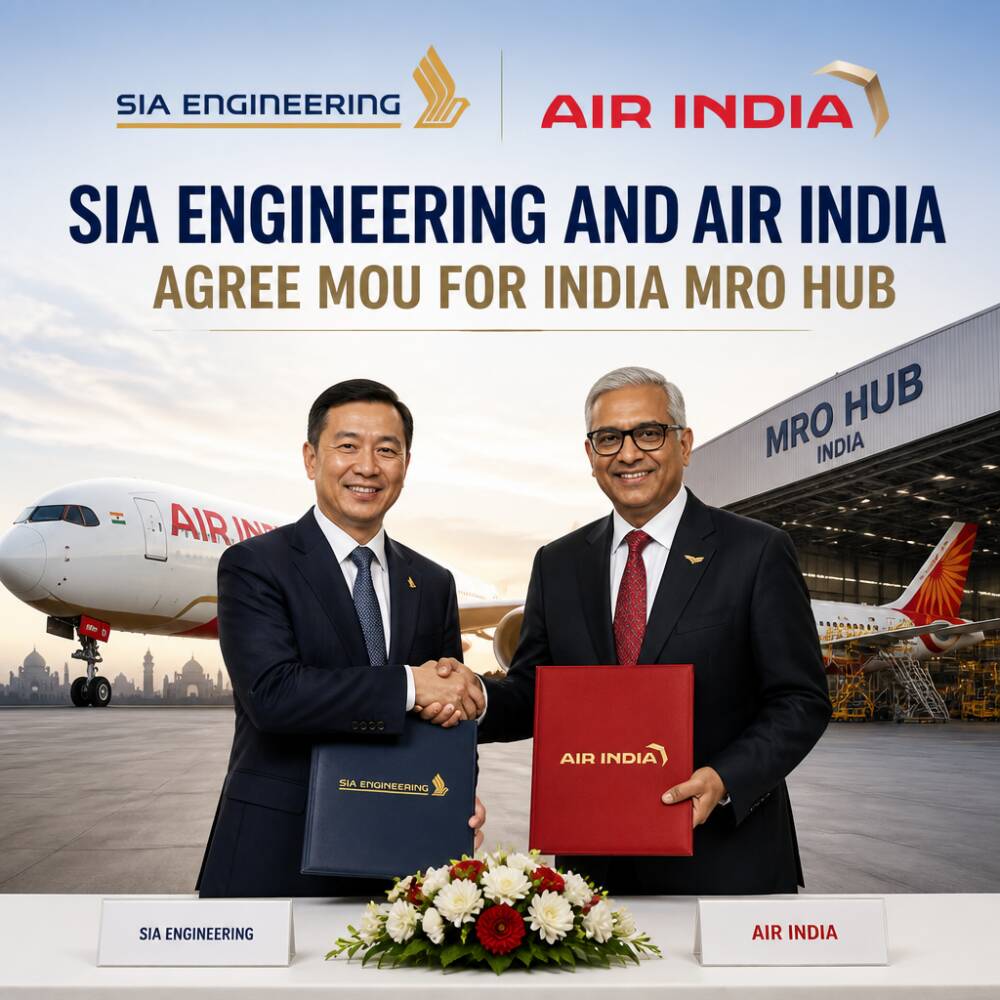
Singapore’s SIA Engineering Company Limited (SIAEC) and Air India have signed a legally non-binding memorandum of understanding to explore collaboration in maintenance, repair and overhaul (MRO), aiming to support India’s push to become a global aviation MRO hub. The agreement focuses on combining SIAEC’s MRO know-how with Air India’s airline network to develop an India-based MRO ecosystem tailored to domestic and regional demand.
The proposed cooperation could eventually include plans to form a joint venture for an MRO facility in India, though the MOU is not binding and signals an exploration phase rather than a committed deal. Air India is an associated company of Singapore Airlines Limited, which owns a 25.1% stake in the airline, and SIAEC’s chief executive, Goh Choon Phong, sits on Air India’s board—an arrangement that underscores the strategic alignment between the parties.
Key takeaways
- What happened: SIA Engineering Company and Air India signed a legally non-binding MOU to explore MRO collaboration.
- Catalyst: Aimed at building an India-focused MRO ecosystem using SIAEC’s technical expertise and Air India’s operational footprint.
- Potential next step: The parties may consider establishing a joint venture MRO facility in India.
- Implication: If expanded into binding agreements, the effort could strengthen India’s capacity to serve growing regional and domestic aircraft maintenance needs.
What the MOU is designed to do
According to the companies, the MOU is intended to deepen collaboration across the MRO value chain. The focus is on leveraging SIAEC’s established capabilities in maintenance and overhaul alongside Air India’s extensive airline operations network, with the objective of creating a “world-class” MRO ecosystem in India.
By targeting an MRO footprint within India, the initiative is positioned to address aircraft maintenance demand from both domestic operators and regional routes. The companies said the broader goal is to help meet the growing requirements of aviation markets that depend on timely and cost-effective aircraft servicing.
Why India’s MRO ambitions matter
India has been positioning itself as a potential regional hub for aircraft maintenance and servicing, driven by expanding airline fleets and rising utilization across domestic and nearby international routes. In that context, an entry by a specialist engineering provider with established MRO experience could lower execution risk for projects such as facilities, workforce training, and process standardization—factors that often determine how quickly MRO capacity can scale.
The MOU’s emphasis on “meeting the growing demands” of domestic and regional aviation markets aligns with that broader industrial push. For investors and industry participants, the key question is whether the collaboration can translate from an MoU into a scalable operating model that can win aircraft maintenance work across airlines operating in the region.
Corporate ties and governance alignment
Air India is described as an associated company of Singapore Airlines Limited, which holds a 25.1% stake in the airline. The governance link is further reinforced by the fact that Goh Choon Phong, who serves as Director of SIAEC and CEO of SIA, also sits on Air India’s board.
That structure can matter in early-stage industrial partnerships because it may facilitate faster coordination on planning, technology transfer considerations, and commercial alignment between operating airlines and engineering services. Still, the document is explicitly legally non-binding, meaning the companies have not committed to timelines, investment levels, or the precise structure of any future joint venture.
What to watch next
The immediate development to monitor is whether the MOU progresses to binding agreements, including decisions on the scope of any joint venture MRO facility in India. Investors and industry observers may also look for updates on deal structure, facility location and scale, and how the companies plan to convert the partnership into contracts that support utilization targets.
With aircraft maintenance capacity and turnaround reliability central to airline planning, the next phase of announcements could shed light on whether this collaboration becomes a concrete expansion of MRO capability—or remains an exploratory framework.


