

Dubai Future Finance Week continued on 4 November 2026 with a packed programme focused on private wealth, alternative investment strategies and Sharia-compliant finance, according to Dubai International Financial Centre (DIFC), the event’s lead organiser.
Held from 2 to 6 November 2026, day three was convened under the directives and patronage of His Highness Sheikh Maktoum bin Mohammed bin Rashid Al Maktoum, First Deputy Ruler of Dubai, Deputy Prime Minister and Minister of Finance of the UAE, and President of DIFC, DIFC said. The week is described as aligned with the Dubai Economic Agenda D33, which aims to strengthen Dubai’s position among leading global financial hubs.
Private wealth and alternatives discussions
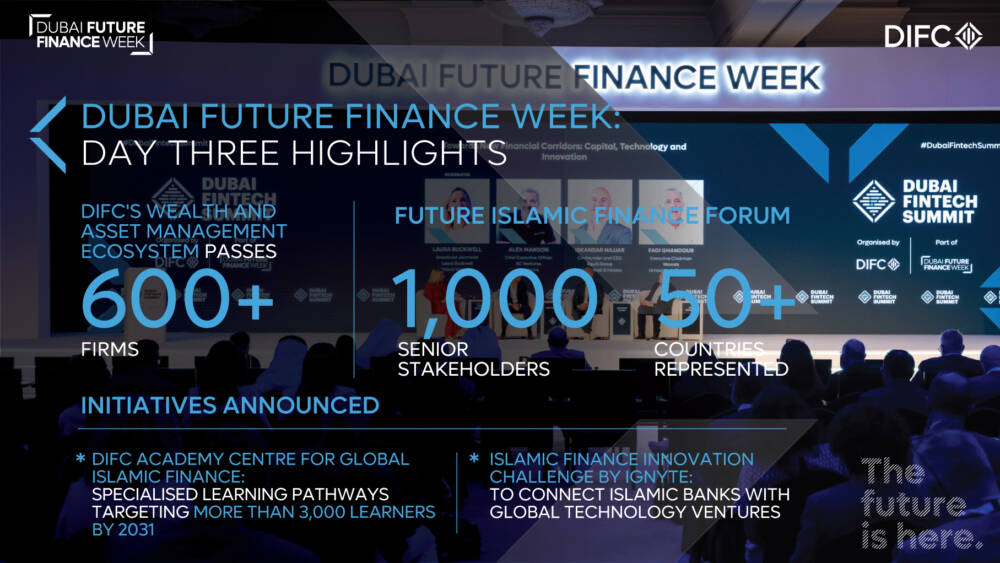
DIFC said it has more than 600 wealth and asset management companies within its ecosystem, describing the figure as triple the number of other centres in the market. The announcement was positioned by DIFC as part of the context for meetings and sessions taking place during the week, including the IPEM Future conference held the previous day, and day three’s DealCatalyst Fixed Incomes Alternatives discussions.
DIFC referenced commentary delivered earlier in the week at the Dubai FinTech Summit by Noel Quinn, Chairman of the Board of Directors at Julius Baer Group, and Jason Moo, Chief Executive Officer of Bank of Singapore. It also said the DealCatalyst programme brought together global asset managers and structured credit investors from Europe and the United States, alongside regional commercial banks, sovereign wealth funds and other financial institutions.
The discussions, according to DIFC, covered private credit, structured finance and alternative funding models, and were framed around growing depth and sophistication in regional capital markets.
Future Islamic Finance Forum
Alongside the private wealth agenda, DIFC said the Future Islamic Finance Forum brought more than 1,000 senior stakeholders from over 50 countries together to examine cross-border liquidity, regulatory alignment and values-aligned capital deployment.
DIFC listed participating speakers and roles including representatives from the Central Bank of the Republic of Azerbaijan, Cambridge Institute of Islamic Finance, Dubai Islamic Bank, Dubai Financial Market, Dubai Financial Services Authority, Gatehouse Bank, the Global Ethical Finance Initiative and Islamic Finance Council UK, London Stock Exchange Group, Romanian Arab Investment House, Salaam, Salihin Shariah Advisory Services, Standard Chartered Saadiq Malaysia, and Standard Chartered Saadiq.
During the forum, DIFC said it unveiled initiatives spanning talent development and technology enablement. Under talent and capacity building, DIFC Academy launched specialised learning pathways through its Centre for Global Islamic Finance, with targets stated by DIFC to reach more than 3,000 learners by 2031. DIFC said the curriculum is structured across beginner to advanced levels in collaboration with academic institutions and global industry partners.
For technology and innovation enablement, DIFC said the Islamic Finance Innovation Challenge by Ignyte is intended to connect Islamic banks with global technology ventures to pilot solutions related to financing, Sukuk structuring, compliance and Takaful. DIFC also announced plans to establish an Islamic Finance Innovation Centre in collaboration with CRDB Bank PLC, Emirates Islamic Bank, Principle Investor Group and Standard Chartered Saadiq.
DIFC described the proposed centre as a collaborative platform to bring together institutions from key Islamic finance markets, linking financial institutions with regulators, Shariah scholars, standards bodies, FinTech companies and technology providers to identify shared priorities and accelerate development and adoption of scalable solutions.
Insurance technology track
Dubai Future Finance Week also included GAIP InsureTek Dubai 2026, which DIFC said introduced a dedicated insurance platform during the event. The track reportedly brought together insurers, reinsurers and brokers to advance risk transfer models, underwriting automation and climate resilience frameworks.
Event framing and forward sessions
DIFC said global financial leaders and institutional allocators were invited to join concluding sessions of Dubai Future Finance Week. DIFC’s release said the closing discussions would address family wealth governance, intergenerational stewardship, tokenisation and digital asset regulation, building on day three’s discussions about tokenisation of Islamic capital markets.
DIFC Authority Chief Business Development Officer Salmaan Jaffery said in the release that the week’s conversations brought expertise together across wealth and asset management, insurance and Islamic finance, and that DIFC’s role was to connect global expertise, capital and opportunity to drive change across the sector.


