

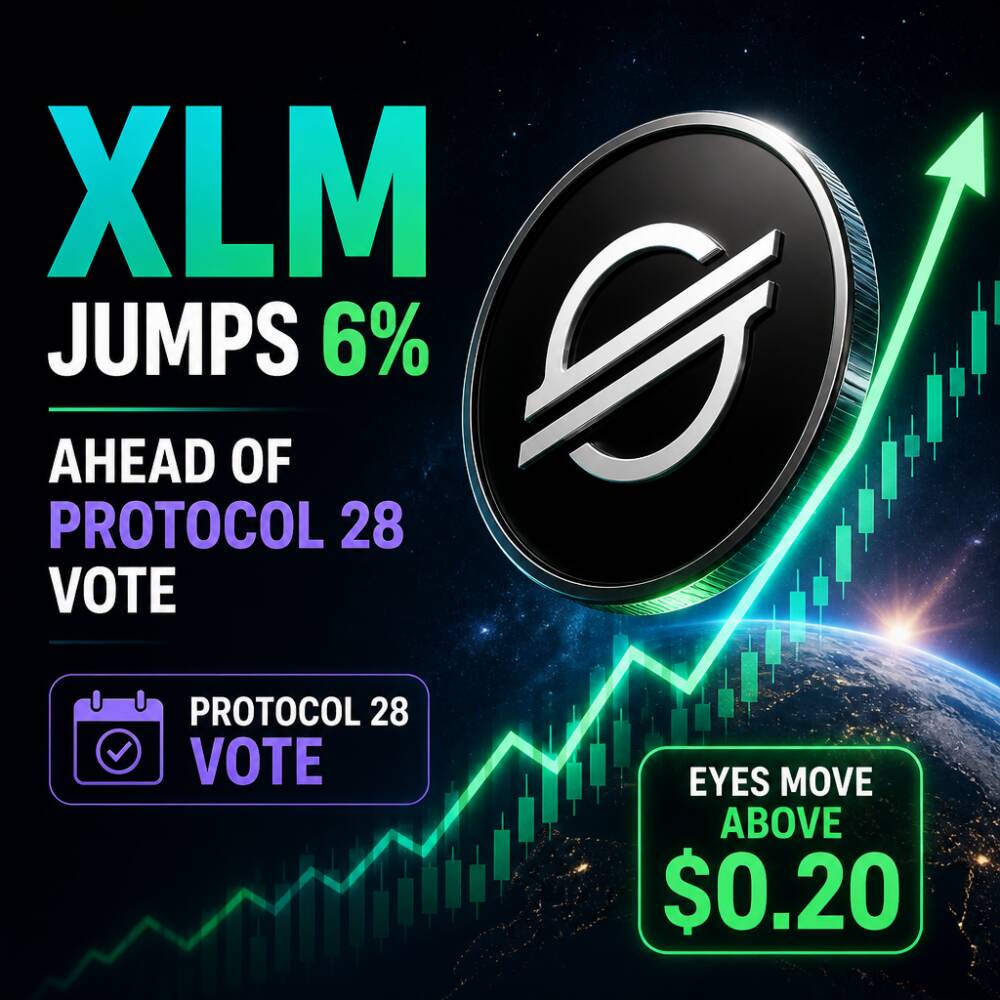
Stellar’s native token, XLM, rose nearly 6% over the past 24 hours to trade around $0.193 on Sept. 15, after moving from roughly $0.182 to an intraday high near $0.197. The rally comes a day ahead of a scheduled vote by Stellar validators on the network’s Protocol 28 mainnet upgrade, with additional momentum supported by recent updates tied to Stellar-based payments.
Key takeaways
- Price move: XLM was up about 5.8% in the last 24 hours, reaching around $0.197 before easing back toward $0.193.
- Catalyst: Traders are positioning for Stellar validators’ vote on the Protocol 28 mainnet upgrade on Sept. 16.
- Payments momentum: Attention has also been drawn to MoneyGram’s Visa card rollout in Colombia, which uses Stellar infrastructure.
- Key level to watch: $0.20 is the first major resistance zone; failure there could pull focus back to earlier support levels.
- Implication: The near-term direction appears tied to whether XLM can sustain strength above its early-September range.
What drove XLM higher ahead of Protocol 28
Most of the immediate Stellar-specific focus centers on the Protocol 28 mainnet upgrade vote. The Stellar Development Foundation scheduled the vote for Sept. 16 at 17:00 UTC, following a Protocol 28 testnet upgrade completed on Aug. 27.
Protocol 28—described by the foundation as an “Adapter” upgrade—includes changes to both Stellar Core and Soroban smart contracts. The update also features CAP-83, which allows validators to begin voting before receiving a complete transaction set and introduces mechanisms to drop late or invalid sets. Additional components, CAP-85 and CAP-86, are aimed at smart contract changes, including upgrade-related behavior and contract data structure modifications.
With the vote scheduled for the following day, investors have treated the event as the most direct network catalyst in the current price move. The upgrade timetable provided the clearest near-term timeline for traders, particularly as the rest of the market awaited concrete outcomes from the validator process.
Why payments developments matter to the market
Beyond the protocol vote, two recent payments-related developments have kept attention on Stellar’s use case for moving and spending value.
First, MoneyGram launched a stablecoin-backed Visa card in Colombia on Sept. 10. The card allows eligible customers to hold a stable-dollar balance and spend at merchants that accept Visa. According to the report, the program was developed with stablecoin payments firm Rain and uses Crossmint wallet technology alongside the Stellar network. At launch, the stablecoin supported was USDC, while MoneyGram plans to add its MGUSD stablecoin later.
The second factor is institutional activity involving stablecoins and settlement flows on Stellar. The Stellar Development Foundation said US Bank completed its first pilot transaction using USBDC, its proprietary dollar-backed stablecoin. The pilot reportedly moved value between US Bank’s entities in North America and Europe over Stellar while remaining connected to US Bank’s finance, risk, compliance, and operations systems. The scope included the stablecoin lifecycle, from minting and payment to redemption, freezing, and clawback, with US Bank and the foundation also evaluating other uses such as liquidity management, collateral mobility, and cross-border treasury operations.
Taken together, the protocol event and the payments-related rollouts form a two-track narrative investors have been monitoring: near-term network changes on the one hand, and real-world transaction and payment rails on the other.
Market reaction and levels traders are watching
Technically, XLM’s latest advance has pushed the token back above its early-September trading range around $0.175 to $0.185, but chart focus remains on whether it can clear $0.20. A daily close above $0.20 would bring prior swing activity near $0.205 to $0.21 back into play, potentially opening the door to further upside if momentum holds.
Data cited in the analysis suggests buying pressure has improved without reaching extreme overbought conditions. The daily Vortex Indicator reportedly turned more favorable for buyers, while the Money Flow Index rose above the neutral 50 level, indicating increased inflows. The analysis also noted that while the token did not appear to show the kind of peak readings seen during XLM’s June spike, the market was still in a phase consistent with continued momentum as long as key indicator relationships remain intact.
On the four-hour chart, the report said trading volume increased as XLM broke above $0.185 and moved toward $0.195. Momentum indicators cited there point to accelerated short-term strength during the push. The near-term resistance zone is described as spanning roughly $0.195 to $0.20, with the $0.20 level framed as the threshold that could confirm the breakout if buyers hold after a retest.
If XLM fails to hold above $0.20, traders may revisit the $0.185 to $0.188 area as the first support region to watch. The analysis further suggests that a breakdown below $0.185 could expose the $0.178 to $0.18 zone, and a move below $0.175 would damage the sequence of higher lows formed since Sept. 11, increasing the risk of renewed selling pressure.
What to watch next
With the Protocol 28 mainnet upgrade vote scheduled for Sept. 16 at 17:00 UTC, investors will likely monitor how the validator process unfolds and whether XLM can sustain strength through the $0.20 resistance area. In the near term, market attention should also remain on ongoing announcements related to Stellar-based payments and stablecoin use, as these developments have been acting as secondary catalysts alongside the upgrade timeline.


