

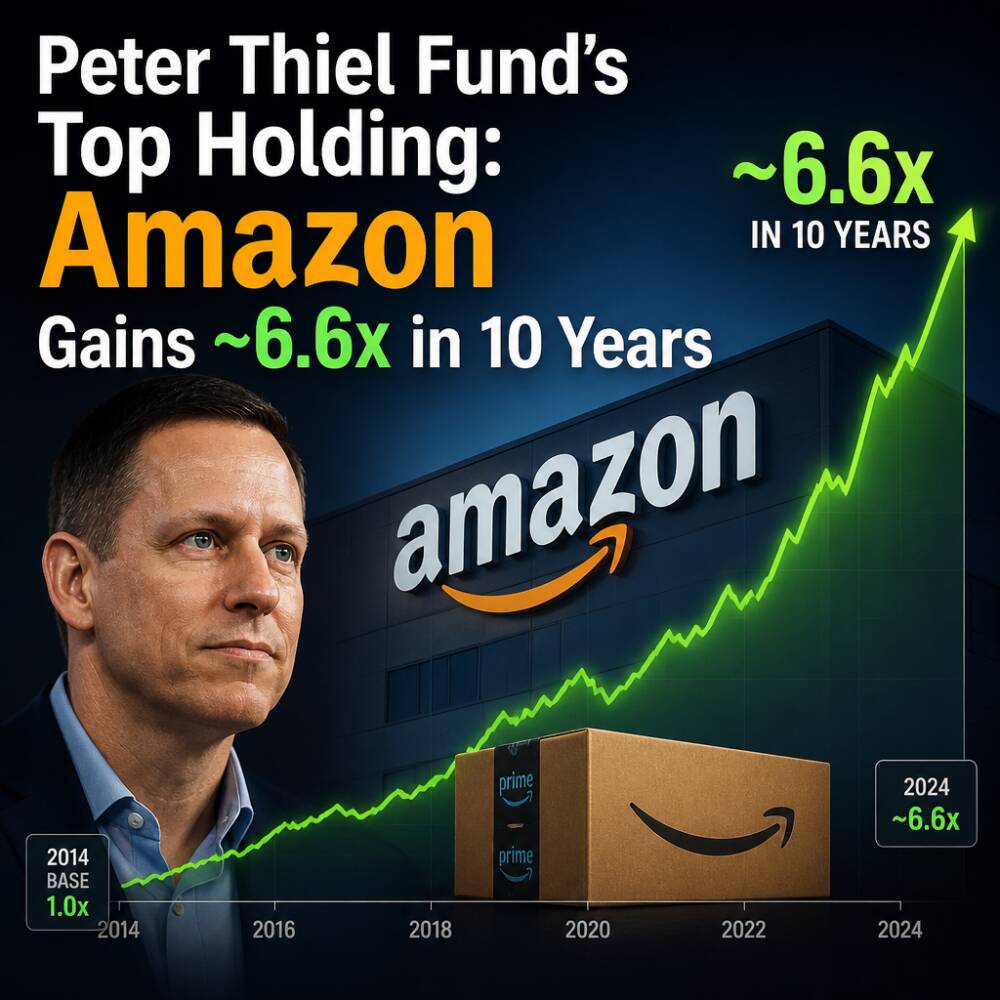
Billionaire Peter Thiel’s hedge fund, Thiel Macro, disclosed its latest portfolio in a recent regulatory filing, showing Amazon as its largest reported holding with a value of about $118 million as of June 30. The disclosure comes as investors continue to focus on how Amazon’s earnings engine—especially Amazon Web Services—has powered a decade-long surge in profitability and share performance.
Key takeaways
- Amazon’s decade-long gain: A $10,000 investment made about 10 years ago would be worth roughly $66,000 today, based on split-adjusted pricing from 2016 to Friday’s close.
- Catalyst behind the returns: Growth in operating income outpaced the stock’s valuation premium, with Amazon Web Services expanding revenue and margins over the period.
- Profit drivers: AWS scaled into a substantially larger contributor to both revenue and operating profit, while advertising became a meaningful incremental revenue stream.
- Implication for investors: The next phase likely depends less on valuation expansion and more on whether profit compounding can continue as Amazon invests heavily in AI infrastructure.
What Thiel Macro’s filing shows
According to Thiel Macro’s latest quarterly filing, Amazon is listed as the fund’s largest position, valued at approximately $118 million as of June 30. The stake underscores ongoing interest from long-term, concentrated investors in Amazon’s ability to convert scale into earnings.
The filing also places Amazon’s performance in sharper context for market participants, because it arrives alongside a decade in which the company’s fundamentals changed dramatically rather than merely improving at the margin.
How Amazon’s profits expanded faster than its stock
Amazon in 2016 looked materially different from the company investors know today. The period’s financial base was modest: the company generated about $136 billion in revenue, $4.2 billion in operating income, and $2.4 billion in net income. At the time, investors were pricing Amazon as a business with limited current profitability relative to the growth expectations.
By 2025, revenue had risen to about $717 billion, and net income had grown to $77.7 billion, representing a large increase in profitability over the decade. The key takeaway for shareholders was that earnings growth compounded at a pace that exceeded the growth implied by the share price, meaning Amazon’s business expansion did more of the work than valuation multiple expansion.
Data cited in the article indicates that shares today trade at roughly 24 times expected earnings for next year, compared with levels that previously implied investors were paying more than 100 times earnings in 2016.
AWS and advertising reshaped Amazon’s earnings profile
Most of Amazon’s transformation traces back to Amazon Web Services. In 2016, AWS produced $12.2 billion of revenue, about 9% of Amazon’s total, and accounted for most of the company’s operating income, with $3.1 billion in operating profit. By 2025, the segment’s revenue had grown to $128.7 billion, and its operating income reached $45.6 billion.
The filing discussion also highlights margin expansion at AWS as it scaled. The article states AWS operating margin improved from about 25% to about 35% over the decade, reflecting both scale benefits and a stronger mix of services.
Growth momentum appears to have remained intact as well. The article cites that AWS segment revenue rose 20% in 2025, with growth accelerating through the year and reaching 24% year over year in the fourth quarter. It also references CEO Andy Jassy’s July comments around faster growth and accelerating contributions from AI- and chip-related efforts.
Beyond AWS, the article points to advertising as another earnings contributor that has grown into a separate profit stream. It notes that advertising generated $19.8 billion of revenue in the second quarter, up 26% year over year, and that the business was not reported as a distinct revenue line a decade earlier.
Can the next decade match the last?
While the past decade delivered a striking return profile, the article argues that replicating a similar level of stock appreciation would require an exceptionally large market valuation—far beyond what any public company currently commands. Instead, it frames the more realistic driver of future shareholder outcomes as continued earnings compounding.
That said, the article also highlights a potential near-term tradeoff. It states that free cash flow over the trailing 12 months turned into an outflow of about $7.6 billion, largely attributed to heavy spending on artificial intelligence infrastructure. For investors, the implication is that capital intensity may remain elevated while Amazon builds capacity for future demand, which can pressure cash generation before returns show up in profitability.
What to watch next
Investors tracking Amazon will likely focus on whether AWS growth sustains its momentum and whether advertising continues to expand faster than the broader company. Equally important will be developments around AI infrastructure spending—specifically how capital outlays translate into future revenue growth and margin durability. Upcoming updates in Amazon’s quarterly results and broader macro conditions affecting consumer demand and technology spending could further shape market expectations.


