

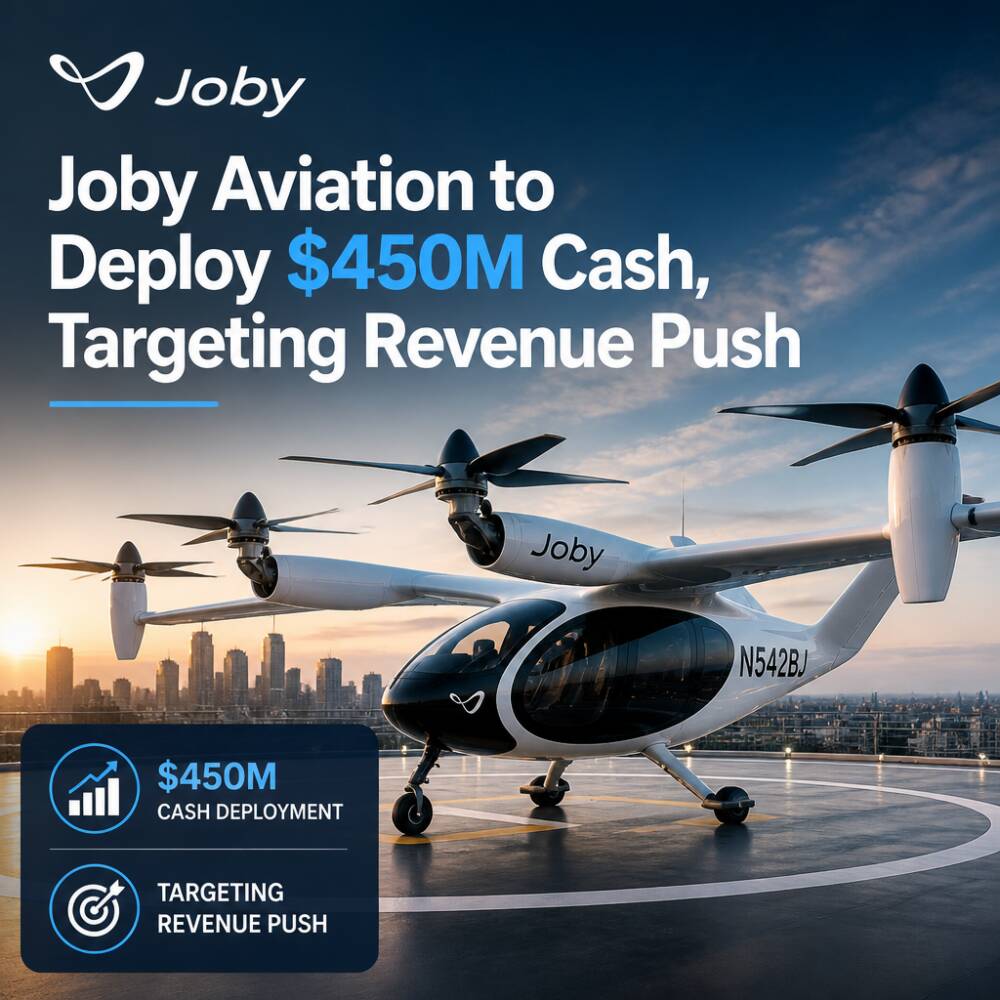
Joby Aviation’s shares traded near their 52-week low, reflecting continued skepticism around the timing of electric air taxi revenue. The company said on Aug. 11 it has agreed to acquire defense technology firm Resonant Sciences for about $500 million, using mostly cash. The purchase is expected to materially expand Joby’s revenue base, but it will not flow into its financial results until the deal closes in the first half of 2027.
Key takeaways
- Price move: Joby Aviation shares were trading below $7 and near a 52-week low.
- Catalyst: The announced $500 million acquisition of Resonant Sciences, largely funded with cash.
- What the deal does: On matched 12-month periods, the transaction is expected to roughly double Joby’s revenue.
- Key implication: The acquisition is not expected to close until the first half of 2027, so near-term financial results from Resonant will be limited.
What drove the announcement
Under the terms disclosed Aug. 11, Joby agreed to buy Resonant Sciences, a Dayton, Ohio-based company that builds radio frequency and mission systems for U.S. national security customers. The company also develops low-observability technology used to help military aircraft sense their surroundings and avoid detection.
Joby said the consideration is about $500 million, consisting of roughly $450 million in cash and $50 million in stock. Management characterized the size as significant enough that, on matched twelve-month bases, it would approximately double Joby’s revenue run rate.
Resonant reported more than $100 million of revenue over its trailing twelve months, up about 40% year over year, and generated positive adjusted EBITDA. Demand for its offerings is described as accelerating, with the first half of 2026 showing more than three times the new business booked compared with the first half of 2025, and a backlog that more than doubled year over year.
Why investors are likely focused on timing
Even with a potentially large revenue contribution, the deal’s closing schedule limits how quickly it can affect Joby’s reported performance. Joby said the acquisition is not expected to close until the first half of 2027, subject to regulatory review. As a result, Resonant’s results are not yet included in Joby’s numbers.
Joby has also been directing attention to its core business, where revenue is still small and contingent on FAA certification progress. The company reported that, for the second quarter, it generated $38.6 million in revenue, with $36.2 million coming from passenger flights booked through Blade, after Joby acquired the business in August 2025. The company’s outlook suggests the second half of the year will not be larger than the first, implying no immediate acceleration from its current operating model.
In its August update, Joby stated it made its strongest quarterly progress yet in the fifth and final stage of FAA type certification. It continues to target its first passenger flights before the end of 2026, with early flights under a federal pilot program expected in Texas this month.
Funding the deal and the impact on cash plans
Joby’s management indicated it can fund the acquisition on the current balance sheet. According to the company, cash and short-term investments were about $2.3 billion at the end of June. Joby expects to use between $385 million and $415 million of that cash in the second half of 2026 alone.
That cash use, combined with the $450 million cash component of the Resonant payment, means a substantial portion of the June 30 cash balance is already earmarked. The $50 million stock portion is expected to be comparatively small in relation to the overall deal consideration. Joby also separately implemented a program to sell up to $750 million of new stock over time, according to the report.
Joby raised significant capital earlier in the year, including about $576 million in net proceeds from a stock offering and about $670 million from an offering of convertible notes. The company is therefore executing this acquisition largely with funding it has already received from investors rather than from operating cash flows generated by its business to date.
How analysts may view the valuation trade-off
Investors may be weighing the trade-off between expanding revenue through acquisitions and the continued uncertainty around air taxi commercialization. As described in the report, almost none of Joby’s current revenue is generated by electric air taxis themselves.
The company reported trailing-twelve-month Resonant revenue of more than $100 million, and the acquisition price is presented as less than five times trailing sales. By comparison, Joby’s market value was described as about $6.7 billion, which would imply trading at more than 50 times the midpoint of its 2026 revenue outlook of $115 million to $125 million. The implication is that the market is pricing Joby primarily on the prospect of significant future air taxi revenue rather than current sales.
Joby’s own outlook calls for 2026 revenue of $115 million to $125 million, while Resonant’s reported trailing twelve-month revenue is described as nearly as large as everything Joby expects to book for the year. In other words, if the acquisition closes as scheduled, the deal could shift the revenue mix—but not immediately in the near term.
Bigger picture for electric air mobility
Resonant’s defense-oriented revenue stream could provide Joby with a more established line of business alongside its air taxi efforts. However, the acquisition does not remove the key gating items for the air taxi model: FAA certification milestones and the start of paying passenger flights, both of which remain central to the company’s growth narrative.
What to watch next includes regulatory progress toward deal approval for the first half of 2027 close, continued FAA certification updates as Joby moves through its final stage, and whether early pilot program flights in Texas translate into stronger demand signals for commercial operations. Investors will also likely monitor how quickly Joby’s cash burn trends alongside the planned cash use later in 2026 and the stock offering program described with the acquisition.


