

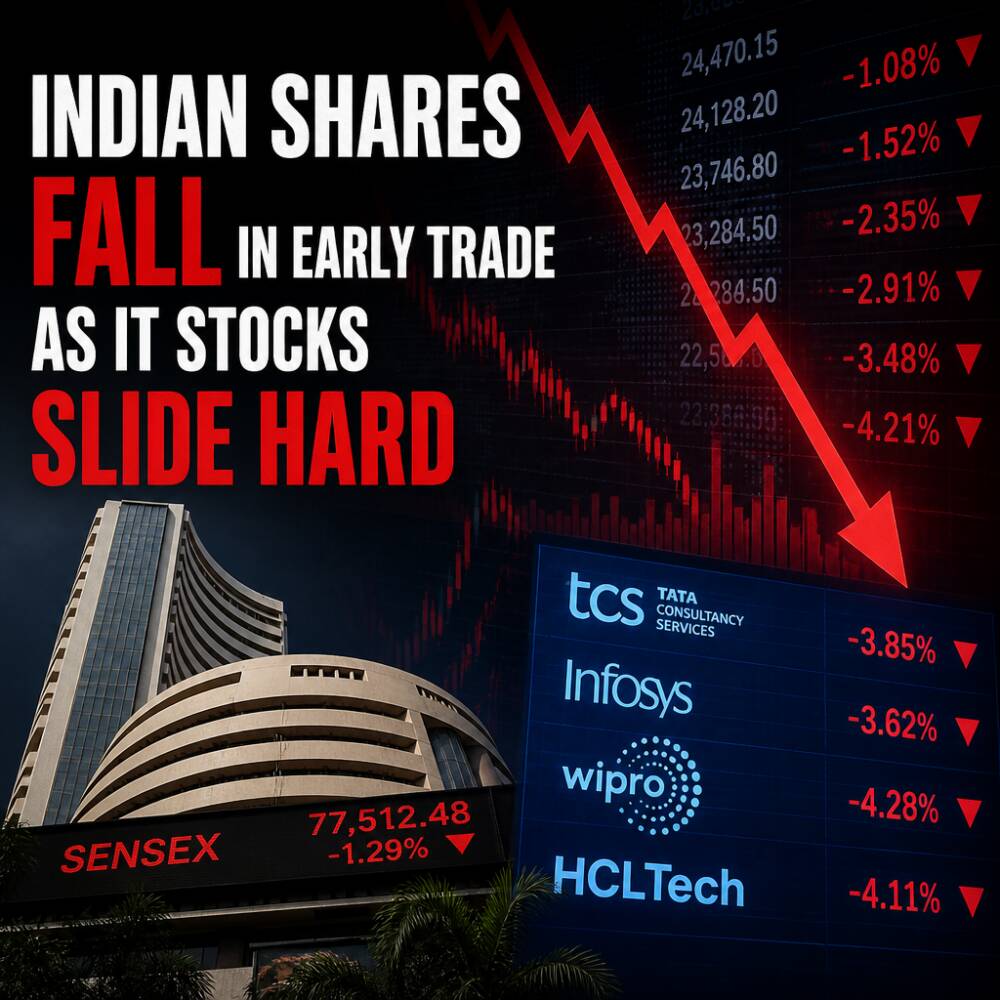
Indian equities fell sharply on Wednesday, with investors turning more cautious as renewed Gulf tensions lifted energy risk and pushed bond yields higher ahead of key U.S. inflation data. The sell-off coincided with a rise in Brent crude toward the $100 a barrel level after Iran launched missiles targeting U.S. military positions in Jordan and urged tanker crews in Bahrain and Kuwait to abandon their vessels immediately.
At the same time, markets looked ahead to inflation readings due this week that could shape expectations for the Federal Reserve’s policy path, including the risk of a rate increase at its September 15-16 meeting. The combined macro and geopolitical backdrop pressured risk assets across India, sending the benchmark indexes lower.
Key takeaways
- Price move: The BSE Sensex declined 620 points (0.8%) to 74,958, while the NSE Nifty fell 163 points (0.7%) to 23,473.
- Catalyst: Renewed Middle East tensions lifted crude oil toward $100 and raised supply disruption concerns, while higher global bond yields weighed sentiment.
- Sector impact: Information technology stocks led declines, as broader Asia saw AI optimism but Indian IT names still sold off.
- Implication: With U.S. inflation data approaching, investors are likely to remain sensitive to rate expectations and global yield moves.
What drove the move
Geopolitical risk in the Gulf resurfaced as a central factor behind Wednesday’s market weakness. Brent crude rose toward $100 a barrel after Iran launched missiles targeting U.S. military positions in Jordan and warned all tanker crews in Bahrain and Kuwait to immediately abandon their vessels, whether at anchor or at ports.
The backdrop follows earlier U.S. action in the Gulf of Oman and near Kharg Island, where U.S. forces reportedly destroyed five Iranian tankers after alleged attempts by Iran to target a U.S. warship with ballistic missiles twice over two days. Together, these developments heightened investors’ concerns about potential disruptions to global oil flows, a theme that typically tightens financial conditions for equities through inflation and growth uncertainty.
Meanwhile, global bond yields moved higher, adding another layer of pressure. In India, where equity valuations can react quickly to shifts in global interest rates, the combination of rising yields and energy risk contributed to a risk-off tone into a data-heavy week.
Market reaction across sectors and large caps
In India’s broader index, IT stocks were the most visible drag. Tata Consultancy Services, Tech Mahindra, HCL Technologies and Infosys each fell roughly 3% to 4%, pointing to sector-wide selling rather than company-specific developments.
While other parts of Asia extended gains for chipmakers amid sustained optimism around artificial intelligence, Indian IT names still underperformed, suggesting investors were prioritizing macro risks—especially higher yields and oil-linked inflation concerns—over the longer-duration AI narrative.
Several other prominent stocks also posted declines. Asian Paints, Bharti Airtel, UltraTech Cement, Bajaj Finance, Mahindra & Mahindra, Hindustan Unilever and HDFC Bank were down in the 1% to 2% range, reinforcing the view that Wednesday’s weakness was broad-based rather than isolated to a single theme.
Financial and corporate-specific moves were more mixed. Fusion Finance dropped 2.2% after transferring a stressed loan of Rs. 35.20 crore to an Asset Reconstruction Company, a development that investors could interpret as part of ongoing resolution efforts for non-performing exposures. On the other hand, Enviro Infra Engineers jumped nearly 6% after securing a Rs. 189.99 crore wind EPC order from Tata Power Renewable Energy, while NLC India rose about 1% after winning a 200 MW wind project.
Innovision surged 12% following an NHAI contract worth Rs. 24.53 crore, highlighting continued investor appetite for new order inflows in specific infrastructure-linked names despite the market’s overall risk-off posture.
What analysts and investors are watching next
With U.S. inflation data due later this week, investors are likely to focus on how the numbers could influence expectations for the Federal Reserve’s September meeting. The index move on Wednesday reflected sensitivity to the rate outlook: higher global yields tend to pressure equity valuations by increasing discount rates and raising the hurdle for future earnings growth.
At the same time, oil-linked uncertainty remains a key variable. If Gulf tensions escalate further or supply disruptions spread beyond tanker warnings, crude prices could stay elevated, complicating the inflation outlook for major economies and potentially tightening global financial conditions through expectations of policy responses.
For Indian markets, Wednesday’s performance suggests a two-track driver set: first, macro—especially yields and the Fed pathway influenced by upcoming U.S. inflation data; and second, geopolitics—through energy risk that can spill into inflation expectations.
Bigger picture
Wednesday’s decline in the Sensex and Nifty underscores how quickly Indian equities can react to external shocks that alter the global rates-and-inflation balance. The sell-off in IT, despite sector optimism elsewhere in Asia, also indicates that near-term macro factors can dominate longer-term thematic trading when yields and commodity risk move together.
As the week progresses, market participants will likely monitor both the data calendar in the United States and any new developments in the Gulf that could change the oil supply risk premium.
Next, investors will watch the upcoming U.S. inflation readings for clues on whether rate expectations need to be revised ahead of the September 15-16 Fed meeting, while also tracking crude price moves tied to Middle East developments.


