

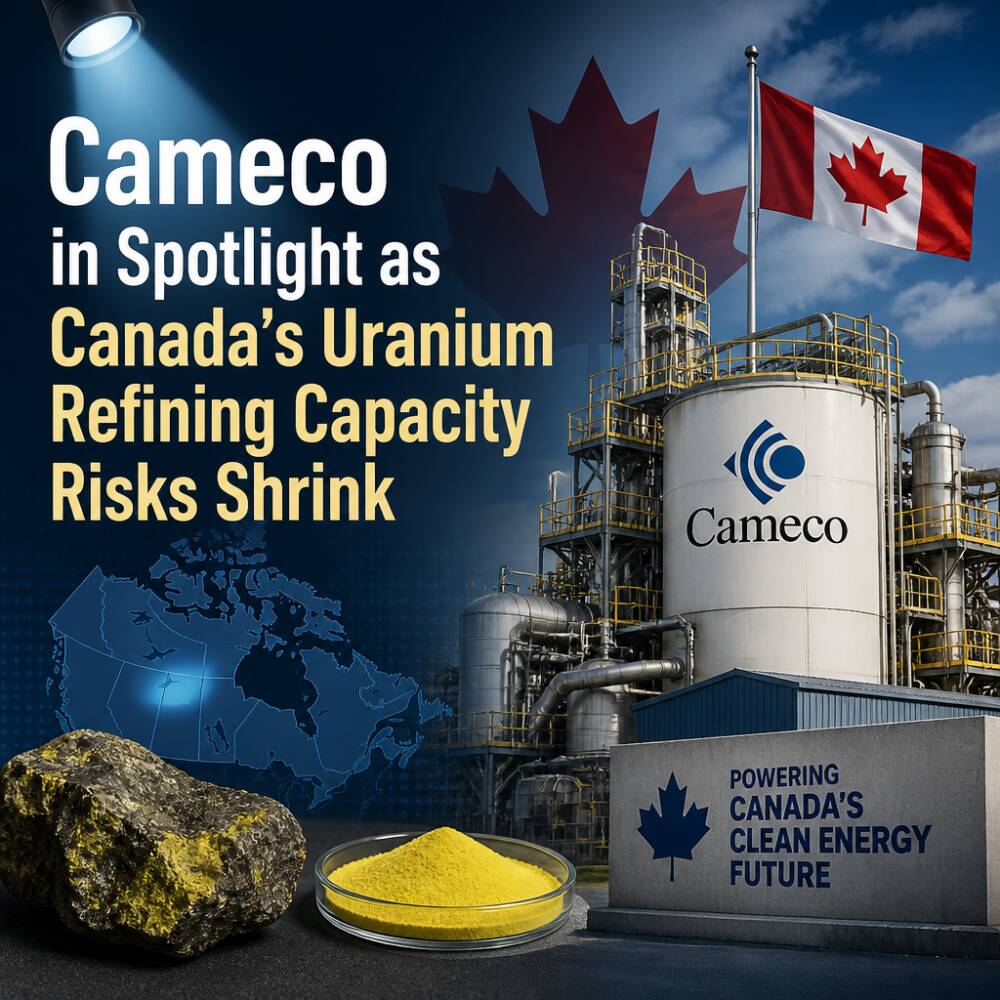
Cameco, the Canadian company that operates the world’s largest commercial uranium refinery, continues to strengthen its position across the nuclear fuel supply chain beyond mining. The company’s Blind River operations refine uranium concentrate into uranium trioxide for subsequent fuel conversion steps, while its Port Hope facilities convert feedstock into forms used for different reactor types—an advantage investors typically weigh heavily when assessing nuclear-fuel exposure.
In fuel services, Cameco has reported sustained production and a contract base that covers conversion work for utilities globally, underscoring its role as a supplier of critical intermediates in nuclear power generation rather than a pure-play on uranium spot-market dynamics.
Key takeaways
- Business model: Cameco runs the world’s largest commercial uranium refinery in Blind River, Ontario, and processes uranium into key intermediates used in nuclear fuel.
- Catalyst: Continued production and long-duration conversion contracting activity support demand visibility for fuel services.
- Strategic implication: Conversion facilities in Port Hope are difficult to replicate, which can help sustain market position as utilities plan nuclear capacity.
- Investment angle: The company provides exposure to reactor-fueled electricity demand through multiple stages of the nuclear fuel cycle.
What Cameco controls in the nuclear fuel cycle
Cameco’s upstream strength starts with refining. After uranium concentrate—often referred to as yellowcake—is processed at the Blind River refinery, Cameco removes impurities to produce uranium trioxide, or UO3. That material is then shipped to the company’s Port Hope facility, where it is converted into forms used as inputs for nuclear fuel production.
Blind River has a current production capacity of 18 million kilograms of uranium annually and is licensed for up to 24 million kilograms. The scale matters because it positions Cameco as a major Western supplier in a market where refining capacity is not abundant.
Why Port Hope matters for conversion and reactor-specific fuel
Mining uranium is only the first step in most reactor fuel chains. Before uranium can be used in reactors, it typically needs refining, conversion, and—depending on reactor design—further processing into reactor-ready fuel.
According to the article, after refining at Blind River, much of the UO3 is sent to Cameco’s Port Hope Conversion Facility. There, Port Hope converts it into either uranium hexafluoride (UF6) or uranium dioxide (UO2). UF6 can be enriched for light-water reactors, while UO2 is used for fuel for Canada’s CANDU reactors, which are heavy-water (deuterium oxide) reactors.
The article further states that Port Hope is particularly difficult to replace: it is Canada’s only uranium conversion facility, a small group of Western suppliers produce UF6, and Port Hope is described as the world’s only commercial supplier of natural UO2 used in CANDU reactor fuel. In investment terms, that kind of bottleneck typically reduces substitution risk—important for investors focused on contracted cash flows and supply continuity.
Fuel-services production and contracting give visibility
The report cited production and contracting indicators for fuel services. Cameco produced 6.3 million kilograms of fuel-services products during the first half of 2026 and continues to expect 13 million to 14 million kilograms for the full year, based on the company’s outlook as presented in the article.
On contracting, the article says Cameco entered 2026 with agreements covering roughly 83 million kilograms of UF6 conversion services for 33 utilities worldwide. For investors, conversion-service contracts can be a key stabilizer because they tie volumes to utility demand for reactor fuel inputs, rather than leaving results fully exposed to day-to-day movements in uranium prices.
A different way to play nuclear growth
While new reactor technologies can take years to move from concept to commercial generation, existing nuclear plants require fuel today. The article argues that Cameco’s position spans both present and future fuel demand: it can sell uranium, refine it, convert it, and manufacture CANDU fuel, and it also holds a stake in Westinghouse Electric Company, linking it—at least indirectly—to the reactor business.
For portfolio construction, the key distinction is that Cameco is positioned within the physical supply chain that turns raw uranium into reactor-ready inputs. As electricity demand rises and utilities look for firm, around-the-clock generation, demand for uranium, conversion services, and nuclear fuel can strengthen—particularly where supply capabilities are limited in specific regions.
The article also frames the replacement challenge as a structural feature of the business environment. It suggests that while Canada may not be “literally unable to survive” without these facilities, replicating them would be extraordinarily difficult. That kind of constraint can translate into strategic leverage when the nuclear fuel cycle tightens.
What to watch next
Investors tracking Cameco’s outlook should focus on updates to full-year fuel-services production guidance, the progression of conversion contracts, and any developments that affect uranium feed supply and the broader nuclear fuel cycle. Upcoming catalysts for the sector typically include utility contracting activity, government and regulatory changes affecting nuclear supply chains, and macro factors such as interest-rate expectations that can influence valuation for long-duration infrastructure-like businesses.


