

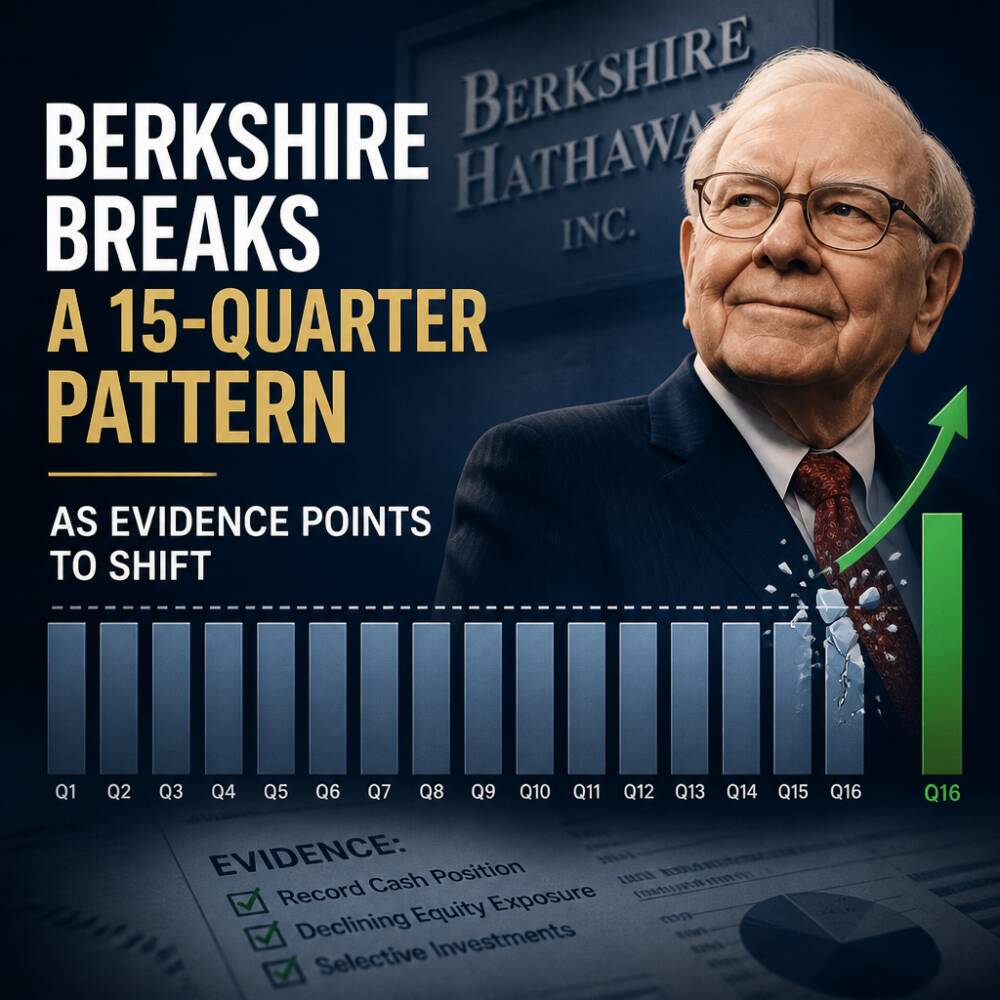
Berkshire Hathaway’s shift from years of net stock selling to a new round of purchases has re-energized attention on how Greg Abel, the hand-picked successor to Warren Buffett, is positioning the conglomerate’s equity portfolio. In the most recent quarter cited in the report, Berkshire returned to being a net buyer of stocks for the first time since 2022, adding nearly $20 billion in purchases, including a major increase in its holdings of Alphabet.
Key takeaways
- Berkshire Hathaway became a net buyer of stocks again in the latest quarter, ending a streak that had lasted 14 straight quarters of net selling.
- Investors focused on a sharp expansion in Alphabet, with Berkshire lifting its Alphabet Class A and Class C positions materially.
- Buffett’s approach still anchors the strategy, with a recent shareholder letter emphasizing that “very infrequently” opportunities become compelling enough to act.
- The implication for markets is cautious: the report suggests any follow-through that helped in 2022 may be harder to replicate given today’s higher equity valuations and a more uncertain macro backdrop.
What drove Berkshire’s decision?
Berkshire Hathaway’s move comes after a prolonged period in which Warren Buffett’s team—prior to Abel’s tenure as CEO earlier this year—had more consistently sold equities than bought them. According to the report, Berkshire was a net seller of stocks for 14 consecutive quarters, including the first quarter of this year.
That pattern changed in the second quarter, when Abel departed from the earlier selling bias. For the first time since 2022, Berkshire became a net buyer of stocks, with almost $20 billion in purchases, the report said. A centerpiece of the buying was Alphabet, where Berkshire increased both Class A and Class C shares significantly.
The report also links Berkshire’s equity patience to Buffett’s stated investment philosophy. In a 2024 shareholder letter referenced by the report, Buffett wrote: “Often, nothing looks compelling; very infrequently we find ourselves knee-deep in opportunities.” The timing of Berkshire’s shift is therefore framed less as a change in philosophy and more as a change in opportunity availability.
Market reaction and what investors are watching
The report draws a comparison to 2022, when Berkshire was last a net buyer of stocks. It notes that following the company’s net buying in the third quarter of 2022, the S&P 500 went on to rise over subsequent months, with that broader rally continuing. Investors appear to be watching whether Berkshire’s latest purchases could align with a similar inflection point in equity sentiment.
However, the report cautions that the environment that supported equities in 2022 differs from today. One key factor highlighted is valuation. Using the S&P 500 Shiller CAPE ratio—an inflation-adjusted measure of price relative to earnings as described in the report—the authors argue stocks are at one of their priciest levels ever, with the last comparable period cited as the dot-com bubble in 2000.
The report also points to macro conditions. It contrasts the 2022 period, when the Federal Reserve was raising interest rates to combat inflation, with the present backdrop described as more uncertain—featuring rising inflation pressures tied to President Donald Trump’s tariffs on imports and conflict in Iran, alongside a Federal Reserve that, at the time of the report, had not yet moved decisively on interest rates. Higher valuation and policy uncertainty, the report suggests, reduce the odds of equities “soaring” in the way they did during earlier net-buying periods.
Bigger picture: quality, timing, and uncertainty
The central takeaway from the report is that Berkshire’s return to net buying may offer signals about where management sees opportunity, but it is not presented as a guaranteed catalyst for broad market gains. Instead, it implies that investors should interpret Berkshire’s actions through the lens of valuation and macro headwinds.
By emphasizing that opportunities become “knee-deep” only “very infrequently,” the report frames Berkshire’s buying as selective rather than cyclical. At the same time, it argues that the combination of elevated equity valuations and an unsettled rate/inflation outlook could mean investors face a less forgiving setup than in 2022—raising the case for focusing on individual quality holdings and maintaining a long-term perspective.
Investors will likely watch Berkshire’s subsequent filings and portfolio changes for confirmation that the recent pivot is sustained. Near-term market sensitivity is also expected to remain high to Fed decision-making and further inflation data, since the report ties today’s uncertainty directly to interest-rate expectations. For equities broadly, the next question is whether falling uncertainty and stable earnings expectations can offset the valuation premium implied by the Shiller CAPE ratio.


