

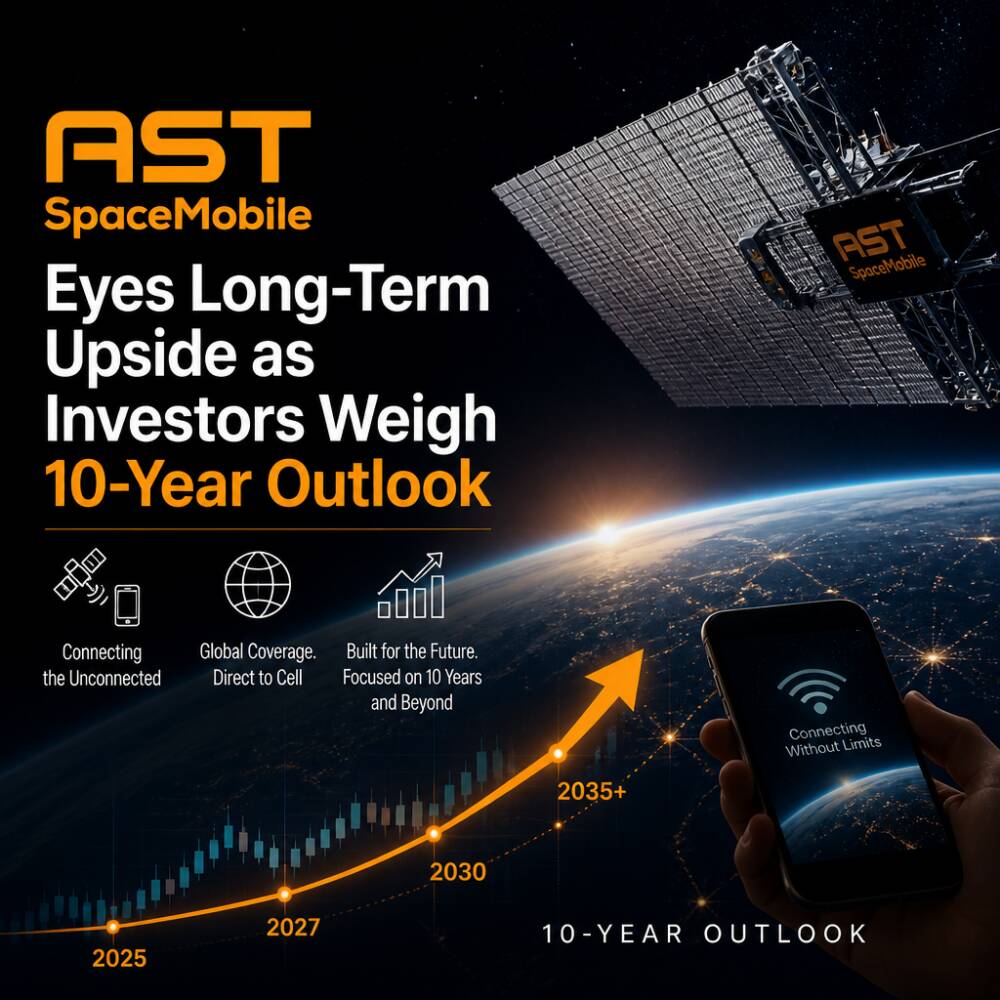
Key takeaways
- AST SpaceMobile shares have more than fivefold since going public in April 2021.
- The catalyst has been progress on its large low Earth orbit satellite network designed to extend cellular connectivity to remote areas.
- A growing commercial backlog reached $1.3 billion by the end of the second quarter of 2026, supporting expectations for faster revenue scaling.
- Despite the momentum, valuation risk remains as the company trades at about 11 times projected 2028 sales, implying investors are underwriting substantial future execution.
- The implication for investors: the stock remains a volatile, high-upside bet tied to satellite deployment milestones and carrier adoption.
AST SpaceMobile, the developer of large low Earth orbit satellites for mobile connectivity, has risen more than fivefold since its public debut through a merger in April 2021. While the company’s commercial progress has attracted investors, the stock also reflects heightened expectations for deployment, revenue growth, and carrier uptake in a still-emerging market.
The company is building a satellite constellation aimed at helping telecom operators extend wireless service coverage beyond dense urban footprints. Its recent performance underscores investor focus on near-term execution—launches, in-orbit progress, and contracting—rather than long-term aspirations alone.
What drove the stock’s climb
AST SpaceMobile’s strategy centers on low Earth orbit satellites designed to bring cellular service to remote and underserved areas. According to the report, the satellites are much larger than SpaceX’s Starlink satellites, positioning AST’s network for direct integration with mobile networks rather than relying solely on ground-based infrastructure.
Operationally, the company has launched 13 BlueBird satellites to date, with 12 currently in orbit. The incremental nature of satellite deployment is a key swing factor for investors in space infrastructure names: each successful launch and in-orbit validation can reduce technical risk and improve confidence in schedule adherence.
AST also said it intends to scale its constellation to 45 satellites by early 2027, and to more than 248 satellites over the next few years. For investors, that roadmap is central to the market narrative—whether the company can transition from early system demonstration to a network capable of supporting meaningful commercial service volumes.
Backlog growth and carrier demand
One of the most concrete datapoints cited is AST’s backlog. According to the report, backlog reached $1.3 billion at the end of the second quarter of 2026—equivalent to nearly eight times the company’s projected $169 million full-year revenue.
The backlog figure matters because it can indicate contracted or committed demand from telecom carriers, potentially improving visibility for revenue generation as satellite capacity comes online. The report also states that by 2028, analysts expect revenue of $1.73 billion, reflecting the assumption that more carriers adopt satellite-based connectivity over time.
On customer reach, AST is working with more than 60 carriers worldwide, including AT&T and Verizon, with the aim of reaching over 3 billion wireless subscribers. That subscriber scale is often viewed by investors as an indicator of addressable market size, though it does not eliminate uncertainty around adoption rates, service utilization, and the timing of revenue conversion.
Valuation: expectations remain demanding
Despite the progress, the stock’s valuation highlights the pressure on execution. The report says AST has a market capitalization of $18.7 billion and already trades at about 11 times projected 2028 sales.
In practical terms, that valuation implies investors are not just pricing in satellite launches; they are pricing in commercial traction and meaningful scaling by the end of the decade. Any delay in deployment milestones, slower carrier onboarding, or weaker-than-expected revenue conversion could challenge the multiple and pressure the stock.
At the same time, investors often treat space and satellite infrastructure businesses as “option-like” positions—where early-stage progress can unlock substantial upside. The report frames AST as a volatile but promising play tied to the nascent low Earth orbit connectivity market.
What to watch next
Investors will likely focus on measurable steps toward capacity expansion: continued launch performance, in-orbit system validation, and whether the company can move from contracted demand to sustained service revenue. With AST targeting a larger constellation by early 2027 and significantly higher satellite counts thereafter, the next key catalysts will be execution against its deployment timeline and updates on carrier rollouts.


